
Trooping the Colour: the pagentry of the Queen’s official birthday
 Comments (5)
 What is Trooping the Colour?

The Welsh Guards standing to attention during the Queen's inspection of her troops
Trooping the Colour is an event held on one of the first three Saturdays in June every year in London to celebrate the Queen’s official birthday.
The Colour in question is the Colours of a regiment. This was the flag of a regiment which was held at the centre of a regiment while they were fighting.
The Colours were trooped in front of the soldiers of the regiment everyday, to make sure that in battle individual soldiers were sure which their regiment was.
The Queen was actually born on the 21st April, her real birthday. Since the time of Edward VII, the Monarch has had an official birthday in June (in the hope that the British weather will be better in June than whenever an individual King or Queen happened to be born).
There are five Household Regiments, the Grenadier Guards, Coldstream Guards, Scots Guards, Irish Guards and Welsh Guards; each takes its turn year by year.
The actual ceremony is a large one. Army regiments take it in turns to take part. Approximately 1400 officers and other ranks are on parade in the Trooping of the Colour, and 200 horses as well. The music is provided by approximately 400 musicians.
In 2009, the Trooping of the Colour the Queen’s Birthday Parade is on 13th June 2009, the Colonel’s Review is on Saturday June 6th, and the Major General’s Review on 30th May.
History of Trooping the Colour

The Massed Band, drawn from different regiments, shown at the June 2007 Trooping the Colour
Armies and regiments have had identifying symbols in the English army since early medieval times.
A standard bearer would hold the flag or symbol of the regiment near to the leader of it, for example, the “Sunne in Splendour” of the Yorkist troops during the Wars of the Roses in the 15th century.
The current ceremony of Trooping the Colour goes back to the time of King Charles II, in the 17th century. The foot guards in London, guarding the Sovereign and royal buildings, trooped their Colour daily from 1755 as part of their daily guard rituals.
The Trooping the Colour parade was held for the first time to celebrate the King’s birthday in 1805.
The embroidered regimental Colours now mark battles and engagements in which a regiment has fought, and in which men from the regiment have fallen for the country.
Each Regiment’s Own Colours
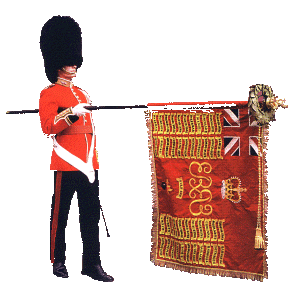
From 1751 infantry regiments have been allowed to carry two Colours, the King’s or Queen’s Colours and the regimental Colours.
At the Trooping of the Colour, the Colours paraded are the Queen’s Colours.
Apart from the Second King Edward VII’s Own Ghurkha Rifles, rifle regiments don’t carry Colours. Cavalry regiments carry either guidons or standards.
Before being used, the Colours are consecrated in a special church service, and when an individual set of Colours is retired, they are given an honourable retirement in public often church building.
What happens at the Trooping the Colour parade
Events begin at about 10 o’clock in the morning. The Queen, and other members of the royal family who attend in two mid Victorian horse drawn carriages parade from Buckingham Palace, along the Mall, to Horse Guard’s Parade and Whitehall.
The royal carriages arrive at precisely 11 o’clock, and the Royal Salute is offered to the Queen. Then comes the inspection of the line, when the Queen drives in her carriage down the ranks of all the guards and then pass the Household Cavalry.

- The Queen inspecting her troops from her carriage, June 2007
The Queen’s royal horses, which she uses on ceremonial occasions, are kept at the Royal Mews, and she has about 30 of them.
In addition to driving the Queen around on ceremonial occasions, the horses are also used in other state processions and some represent Great Britain in national and international carriage driving competitions.
The Queen arrives at her post and dismounts from the carriage, standing to receive the Royal Salute as guards present arms and the assembled military band play the National Anthem.
As the Queen and other members of the royal family inspect the guards and the cavalry, the bands continue to play various patriotic and relevant tunes.
The Queen is accompanied not only by members of the royal family but her Master of the Horse, the Crown Equerry, the Equerries in Waiting, and the General Officer commanding the London district.

The Queen attending Trooping the Colour on horseback, riding side saddle, in 1986.
After inspecting all her troops the Queen arrives back at her platform and stays there for the rest of the ceremony.
After some marching about by the massed bands, the Escort for the Colour marches in quick time to the British Grenadier’s tune.
The Ensign for the Colour and the Regimental Sergeant Major salute the Colours and receive it from the Sergeant of the Colour party.
After the Regimental Sergeant Major has done his saluting, he receives the Colour, and the Ensign then salutes it, sheaths his sword, and puts the Colour in his Colour belt.
The Escort for the Colour is now the Escort to the Colour, as it is safely received, and the Escort marches in slow time through the ranks of the assembled guards, trooping it all of the ranks.
Each regiment of the Foot Guards then march in slow time along the parade ground. Led by the Escort to the Colour, who flourishes (lowers) the Colour as he passes the Queen, and raises it again afterwards. The band continue playing songs such as Men of Harlech.
The massed mounted bands of the Household Cavalry then have their turn of marching passed the saluting point.

The Queen and other members of the Royal Family on the balcony at Buckingham Palace after the Trooping the Colour
After all the marching passed has been done, the Queen gets in her carriage again and goes back down The Mall, leading her soldiers, to Buckingham Palace.
The parade ground markers march from Horse Guard’s Parade back to their barracks.
With the troops following, the Queen waits after she gets out of her carriage at the gates of Buckingham Palace and the whole parade marches passed her again and salutes.
All members of the royal family in attendance then go into Buckingham Palace and onto the balcony for an RAF flypast.
In Green Park, opposite Buckingham Palace, the King’s Troops, Royal Horse Artillery, fire a 41 gun salute.
The Royal Standard flies from Buckingham Palace, showing that the Queen is in residence.
From her accession to the throne in 1952 until 1987, the Queen attending the Trooping of the Colour riding in a side saddle. Since 1987, she has taken the Trooping of the Colour in a horse drawn carriage.
For more information about every march, twist and turn of the Guards, see this article. The official Army’s website about Trooping the Colour can be found here.



