The Year Without a Summer: 1816
 Comments (14)
 1815 represented a pretty good year for the United Kingdom. The “damn close run thing” at Waterloo had seen, finally, Napolean’s defeat. Peace had come, and the UK was on the winning side of it. Life looked good, the future looked bright.
But the next year, disaster came, and 1816 came to be known as “The Year Without a Summer”.
There were serious consequences all over the world, particularly for Northern Europe and North America. This post looks at the disaster and the consequences in this country.
Why no summer?

Map showing variation from normal temperatures in Europe in the "Year Without a Summer", 1816
In April 1815, however, there had been a massive explosion. Mount Tambora volcano, in the Dutch East Indies (modern-day Indonesia), has been erupting since 1812, went bang.
38 cubic miles of pyroclastic material was ejected into the atmosphere. The ash column rose to about 140,000 feet. It was probably the largest ash explosion since the last Ice Age.
This followed four other serious volcanic events, which had taken place over the previous 4 years, so there was already a fair amount of volcanic dust and ash in the atmosphere.
In addition, solar activity had hit a periodic low point. So there was a confluence of damaging events.
The ash and dust in the atmosphere took a while to circulate, therefore there was a “summer” in 1815 (although it had been cold and wet for a few years, because of the other eruptions and the solar minima).
The vast quantities of volcanic debris in the atmosphere restricted the amount of sunlight which reached the earth’s surface, and there was a huge quantity of sulphur floating around the earth.
There is an article here, from History Magazine, about the effects of various volcanic eruptions.
The weather in England in the summer of 1816

Mount Tambora Volcano in 2006
It was cold, wet, and miserable. It snowed near London at Easter, in May and at the end of July, for example - a long way from typical weather in the south of England.It rained most days from May to September - 142 out of 153 days in the Lake District. There were snow drifts in the Lake District in July, and ice on London ponds in September.
World-wide temperatures dropped significantly, and it was one of the coldest summers in English records (from the 16th century onwards).
Agriculture and crop failures
Crops were damaged by cold rainfall, and didn’t grow properly because of a lack of sun. Many crops rotted in the fields before they could be harvested, and more rotted after harvesting, because it was so damp.
In western England, Wales and Ireland, there were near-total crop failures in some areas. Farm labourers found themselves out of work in large numbers, and added to the soldiers who had been demobbed after the end of the Napleonic Wars.
Social consequences of the year without a summer
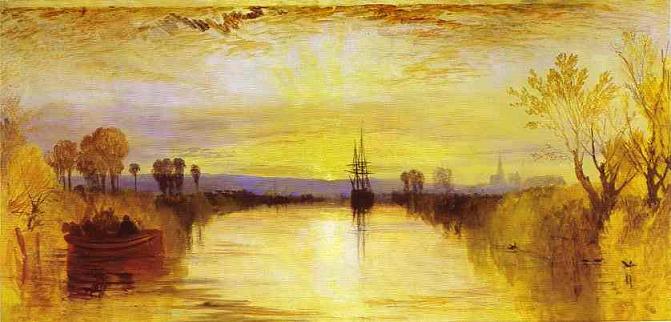
Chichester Canal by J M W Turner
All hell broke loose, not surprisingly. Unemployment rose sharply, and famine threatened. The price of basic food stuffs soared, and many people went very hungry. Disease and infection rose, because of malnutrition and the wet conditions.
Riots and disturbances occurred all over the country. In one riot, over 100 food shops were broken into and ransacked, and the Luddite movement, which had been suppressed by 1813, re-gained power - in one attack on a factory in Loughbrough, over £6,000 worth of machinery was broken.
Mary Shelley, on holiday with friends in Switzerland, took advantage of the foul weather to write Frankenstein. And the wonderful sunsets inspired artists, including Turner.