County Hall - once London’s government, now hotels, art and fish
 Comments (15)
 London’s Local Government
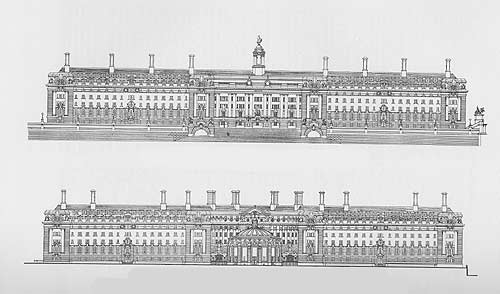
The original plans for London County Hall, from 1909
Until the late 19th century, “London” was just the “square mile”, or what is now known as “the City”, the area within the Roman and medieval walls.
The rest of what is now Greater London was the City of Westminster, part of other counties, such as Kent, Middlesex and Essex, or local parishes and boroughs (such as Southwark).
In 1889, the London County Council (LCC) was formed, covering what is now thought of as Inner London (which excludes the City of London itself, independence is maintained there).
In 1965, the body expanded to cover the City’s growth since Victorian times, and was re-named the Greater London Council (GLC).
From 1965 to 1986, the GLC ran many parts of London’s public sphere, co-operating with the local councils.
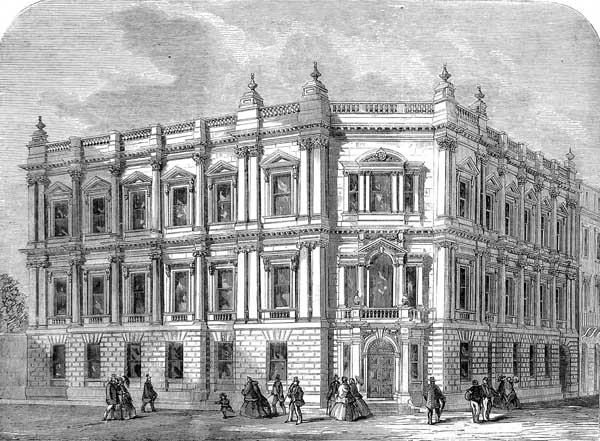
The LCC's first home, formerly the Metropolitan Board of Works
From 1986 to 2000, London was the only major city in the world not to have its own governing body, instead the city was run by the many local councils which make up the urban area – this caused many problems over matters which affected the whole city, such as management of the river.
The LCC and GLC operated from County Hall, a grand building on the south bank of the River Thames, nearly opposite the Houses of Parliament in Westminster.
The site of London County Hall
The land was originally part of St. Mary’s Lambeth, and was called Peddler’s Acre after the varying myths over a peddler who had owned the land and bequeathed it to the church.
From its foundation, the LCC operated from Spring Gardens, a building erected for and used by the Metropolitan Board of Works, whose functions (among others) the LCC inherited when it was set up.
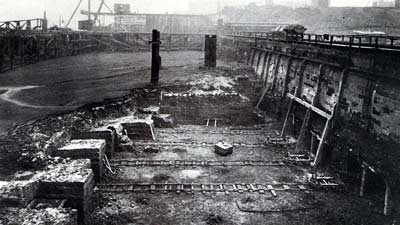
Land was reclaimed from the Thames for the front of the building and the embankment
The large increase in duties conferred on the LCC by the Local Government Act meant the body soon ran out of room, and looked to buy the land just east of Westminster Bridge, to build its own County Hall.
The London County Council bought the land to built its large new home on, and constructions started in the Edwardian era, before the First World War. They paid £617,032 for the land, in 1904.
The building was mostly finished by 1922, with extra bits added here and there until the late 1950s.
While the foundations were being dug for the Hall a number of interesting Roman artefacts were found, including part of a wall and a Roman boat, which were dug up and transferred to the Museum of London.
London County Hall’s architecture
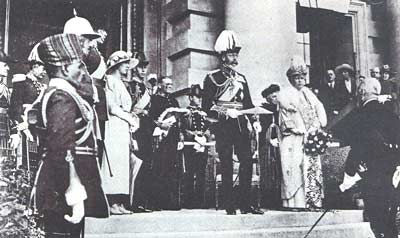
King George V and Queen Mary opening County Hall in 1922
The design of the new building was the subject of a public competition. The winner, out of 51 applicants, was Ralph Knott. The Hall itself is a grand, enormous building.
It’s built with a huge semi-circle in the centre, and two wings extending out along the river.
The building is built mainly from grey stone, with columns along the front and a green, seemingly leaded, tower or spire above the centre and green leading along the windows where the walls meet the roof.
The main stone used was Portland Stone - a grey-white limestone from Dorset which was a common choice for public buildings in London. St. Paul’s Cathedral, the Tower of London, the Bank of England, and Buckingham Place, for example, are all built of Portland Stone.
Now - no politicians, but hotels, sharks, and a museum or two
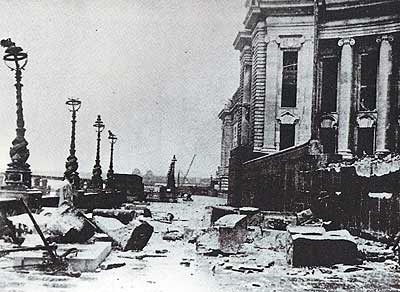
County Hall during the Second World War
The Hall is no longer a local government building – it contains two hotels, one pricey and a cheaper option, and some flats, a gym, a couple of restaurants, and tourist attractions.
The London Aquarium is here - this is a good place to take young children fed up with the round of old churches, national buildings and Old Masters!
The variety of sea life here is amazing – with over a million litres of water in the various tanks, this is one of the largest aquaria in Europe. There’s a huge shark tank, and a recreation of a coral reef which is astonishing in its complexity.
The tanks are positioned so that the visitor can walk underneath, then next to, and then above the same tanks, after using stairs, corridors and lifts. The London Aquarium’s website can be found here.
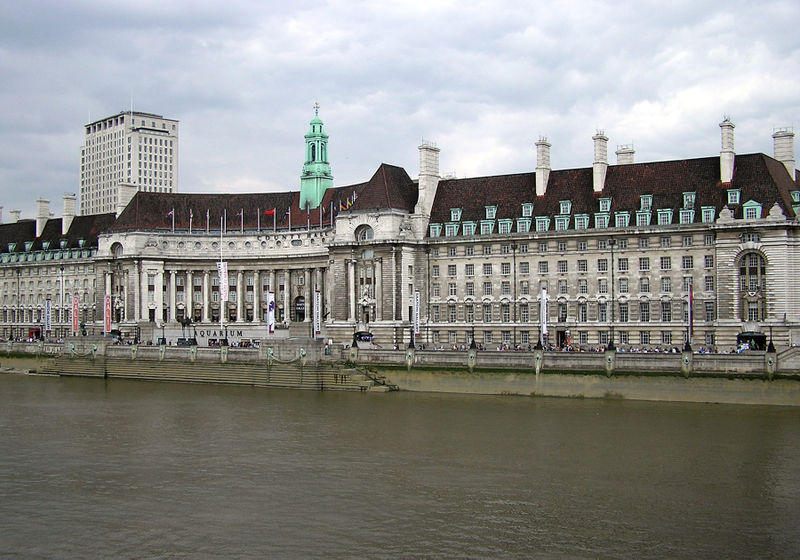
London County Hall, seen from the north bank of the River Thames, by Westminster Bridge
Also in County Hall is the fascinating London Film Museum. This has a mixutre of regular exhibitions and temporary displays, and is well worth a look - the museum’s website is here.
The London Eye is next to County Hall, and has its ground-level offices in County Hall, on the east side of the building.
The Eye has 32 capsules (representing the 32 London boroughs). It’s a beautiful and modern addition to the River Thames’ sky line. Click here for London Eye tickets
The nearest tubes are Waterloo and Westminster.
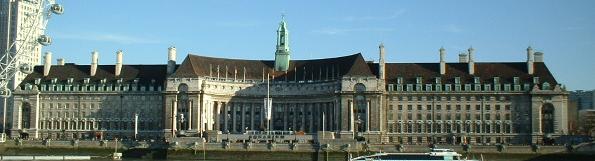
London County Hall, seen from the River Thames