Posts tagged: London

The Frost Fairs: the frozen River Thames in London

By Blog author, January 10, 2010 3:43 am

The Frozen Thames in London - an Introduction

A woodcut showing the medieval London Bridge and Frost Fair on the Thames, 1683

A woodcut showing the medieval London Bridge and Frost Fair on the Thames, 1683

Between 1400 AD and 1814, the last time it happened, the River Thames in London froze over 26 times. And when it froze solidly, Londoners made the most of it, and the “Frost Fairs” developed.

The tidal, somewhat salty Thames is a deep, fast-flowing river today, but before the Old London Bridge was demolished in 1831, the river’s waters were pooled slightly behind the medieval arches, which probably helped the ice take hold.

It was also the time known as the “Little Ice Age”, when winters were colder and more severe than they have been since 1800 or so.

The huge, medieval bridge, with houses and shops above the numerous archways, is shown in the background of the woodcut to the right of this text, depicted during the Frost Fair of 1683.

The text accompanying the woodcut says:
An Exact and lively Mapp or Representation of Boothes and all the variety of Showes and Humours on the ICE of the River of THAMES by LONDON During that memorable Frost in the 35th yeare of the Reigne of his sacred Maj King Charles the 2nd

The embankments had not yet been built, either, and so the River Thames was wider, shallower, and probably a little slower.

The Frozen Thames in the 16th century

The Thames froze over several times in Tudor England. Henry VIII is known to have travelled from Whitehall, next to Westminster, to Greenwich by sleigh, along the River Thames, in 1536. Greenwich was one of Henry’s favourite palaces; he married there more than once, and his daughter Elizabeth I was born there later in 1536.

In 1564, Elizabeth I practised her archery on the frozen Thames, and boys and men played football on the ice.It was said of this winter:

On the 21st of December, began a frost, which continued so extremely that on new year’s eve people went over and along the Thames on the ice from London Bridge to Westminster. Some played at the foot-ball as boldly there as if it had been on the dry land; diverse of the court shot daily at pricks set up on the Thames; and the people, both men and women, went on the Thames in greater numbers than in any street of the city of London.

On the 31st day of January, at night, it began to thaw, and on the fifth day was no ice to be seen between London Bridge and Lambeth, which sudden thaw caused great floods and high waters, that bare down bridges and houses, and drowned many people.

The development of Frost Fairs into full-blown parties

The first frost fair, in terms of full-scale activity and commercial stalls and sports took place in 1608. It was a cheerful and spontaneous affair.

A woodcut showing the Thames Frost Fair  in 1683/1684

A woodcut showing the Thames Frost Fair in 1683/1684

The “Long Freeze” or “Great Freeze” of 1683/4 was one of the coldest-known English, and European, winters. The Thames froze solidly, and the ice was up to a foot deep. The frost began 6 weeks before Christmas, and lasted into February.

Streets of stalls and booths stretched from bank to bank; all London’s normal entertainments made their way on to the river.

A whole ox was roasted at Hungerford Steps, bear-baiting and and puppet-shows were held on the ice. Skating and “chair-pushing” events were also set up.

A pamphlet published about the Long Frost included this passage:

A whole street of booths, contiguous to each other, was built from the Temple Stairs to the barge-house in Southwark, which were inhabited by traders of all sorts, which usually frequent fairs and markets, as those who deal in earthenwares, brass, copper, tin, and iron, toys and trifles; and besides these, printers, bakers, cooks, butchers, barbers, coffee-men, and others, who were so frequented by the innumerable concourse of all degrees and qualities, that, by their own confession, they never met elsewhere the same advantages, every one being willing to say they did lay out such and such money on the river of Thames.

John Evelyn, a diarist, said that:

Frost Fair Mug 1683/4

Frost Fair Mug 1683/4

Coaches plied from Westminster to the Temple, and from several other stairs too and fro, as in the streets, sleds, sliding with skates, bull-baiting, horse and coach races, puppet plays and interludes, cooks, tippling and other lewd places, so that it seemed to be a bacchanalian triumph, or carnival on the water

The mug shown in the picture to the right of this text is tiny, less than 2.5 inches high. Engraved on the base are the words, “Bought on ye Thames ice Janu: ye 17 1683/4″.

It is in the Victoria and Albert Museum in Kensington.

It is astonishing that something so small and delicate lasted to be put in a museum!

The Great Frost of 1709, probably Europe’s coldest winter for 500 years, saw another large-scale frost fair.

Not only rivers, but huge chunks of the North Sea, froze during the terrible cold of the winter, and in France, an estimated 500,000 people died of starvation and malnutrition later in the year. There is a fascinating article from the New Scientist about this winter, called 1709: The year Europe froze.

A London paper said:

The Thames seems now a solid rock of ice; and booths for sale of brandy, wine, ale, and other exhilarating liquors, have been for some time fixed thereon; but now it is in a manner like a town; thousands of people cross it, and with wonder view the mountainous heaps of water that now lie congealed into ice.

On Thursday a great cook’s-shop was erected, and gentlemen went as frequently to dine there as at any ordinary. Over against Westminster, Whitehall, and Whitefriars, printing presses are kept on the ice.

The last River Thames Frost Fair

The Frost Fair on the River Thames in London, 1814, by Luke Clenell

The Frost Fair on the River Thames in London, 1814, by Luke Clenell

The last proper freezing of the River Thames in London took place in 1814.

The frost set in at the start of January, and by the end of the month, the River was frozen solid - an elephant was led across the Thames by Blackfriars Bridge to demonstrate the safety of the ice.

Hoardes of traders and entertainers rushed to set up shop, and the fair was in full-swing. It was shorter than many, as the solid ice lasted only a week.

Writing 20 years later, Charles Mackay said of the 1814 fair:

Each day brought a fresh accession of pedlars to sell their wares, and the greatest rubbish of all sorts was raked up and sold at double and treble the original cost.

The watermen profited exceedingly, for each person paid a toll of twopence or threepence before he was admitted to the fair; and something also was expected for permission to return. Some of them were said to have taken as much as six pounds in a day.

Many persons remained on the ice till late at night, and the effect by moonlight was singularly novel and beautiful. The bosom of the Thames seemed to rival the frozen climes of the north.

Since 1814

Ice on the River Thames in 1895

Ice on the River Thames in 1895

There has, of course, been ice on the River Thames since 1814 - what has not happened since then is the absolute freezing of the water, thick enough to allow lots of activity to take place on the ice.

The photograph to the right of this text shows ice in 1895, with the newly-constructed Tower Bridge in the background.

It looks pretty uneven, and not much fun to walk on!

Trooping the Colour: the pagentry of the Queen’s official birthday

By Blog author, May 26, 2009 1:20 am

What is Trooping the Colour?

The Welsh Guards standing to attention during the Queen's inspection of her troops

The Welsh Guards standing to attention during the Queen's inspection of her troops

Trooping the Colour is an event held on one of the first three Saturdays in June every year in London to celebrate the Queen’s official birthday.

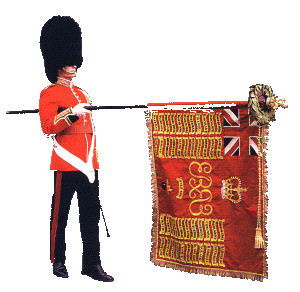
The Colour in question is the Colours of a regiment. This was the flag of a regiment which was held at the centre of a regiment while they were fighting.

The Colours were trooped in front of the soldiers of the regiment everyday, to make sure that in battle individual soldiers were sure which their regiment was.

The Queen was actually born on the 21st April, her real birthday. Since the time of Edward VII, the Monarch has had an official birthday in June (in the hope that the British weather will be better in June than whenever an individual King or Queen happened to be born).

There are five Household Regiments, the Grenadier Guards, Coldstream Guards, Scots Guards, Irish Guards and Welsh Guards; each takes its turn year by year.

The actual ceremony is a large one. Army regiments take it in turns to take part. Approximately 1400 officers and other ranks are on parade in the Trooping of the Colour, and 200 horses as well. The music is provided by approximately 400 musicians.

In 2009, the Trooping of the Colour the Queen’s Birthday Parade is on 13th June 2009, the Colonel’s Review is on Saturday June 6th, and the Major General’s Review on 30th May.

History of Trooping the Colour

The Massed Band, drawn from different regiments, shown at the June 2007 Trooping the Colour

The Massed Band, drawn from different regiments, shown at the June 2007 Trooping the Colour

Armies and regiments have had identifying symbols in the English army since early medieval times.

A standard bearer would hold the flag or symbol of the regiment near to the leader of it, for example, the “Sunne in Splendour” of the Yorkist troops during the Wars of the Roses in the 15th century.

The current ceremony of Trooping the Colour goes back to the time of King Charles II, in the 17th century. The foot guards in London, guarding the Sovereign and royal buildings, trooped their Colour daily from 1755 as part of their daily guard rituals.

The Trooping the Colour parade was held for the first time to celebrate the King’s birthday in 1805.

The embroidered regimental Colours now mark battles and engagements in which a regiment has fought, and in which men from the regiment have fallen for the country.

Each Regiment’s Own Colours

Guard holding the Colours

From 1751 infantry regiments have been allowed to carry two Colours, the King’s or Queen’s Colours and the regimental Colours.

At the Trooping of the Colour, the Colours paraded are the Queen’s Colours.

Apart from the Second King Edward VII’s Own Ghurkha Rifles, rifle regiments don’t carry Colours. Cavalry regiments carry either guidons or standards.

Before being used, the Colours are consecrated in a special church service, and when an individual set of Colours is retired, they are given an honourable retirement in public often church building.

What happens at the Trooping the Colour parade

Events begin at about 10 o’clock in the morning. The Queen, and other members of the royal family who attend in two mid Victorian horse drawn carriages parade from Buckingham Palace, along the Mall, to Horse Guard’s Parade and Whitehall.

The royal carriages arrive at precisely 11 o’clock, and the Royal Salute is offered to the Queen. Then comes the inspection of the line, when the Queen drives in her carriage down the ranks of all the guards and then pass the Household Cavalry.

The Queen inspecting her troops from her carriage, June 2007

The Queen inspecting her troops from her carriage, June 2007

The Queen’s royal horses, which she uses on ceremonial occasions, are kept at the Royal Mews, and she has about 30 of them.

In addition to driving the Queen around on ceremonial occasions, the horses are also used in other state processions and some represent Great Britain in national and international carriage driving competitions.

The Queen arrives at her post and dismounts from the carriage, standing to receive the Royal Salute as guards present arms and the assembled military band play the National Anthem.

As the Queen and other members of the royal family inspect the guards and the cavalry, the bands continue to play various patriotic and relevant tunes.

The Queen is accompanied not only by members of the royal family but her Master of the Horse, the Crown Equerry, the Equerries in Waiting, and the General Officer commanding the London district.

The Queen attending Trooping the Colour on horseback, riding side saddle, in 1986.

The Queen attending Trooping the Colour on horseback, riding side saddle, in 1986.

After inspecting all her troops the Queen arrives back at her platform and stays there for the rest of the ceremony.

After some marching about by the massed bands, the Escort for the Colour marches in quick time to the British Grenadier’s tune.

The Ensign for the Colour and the Regimental Sergeant Major salute the Colours and receive it from the Sergeant of the Colour party.

After the Regimental Sergeant Major has done his saluting, he receives the Colour, and the Ensign then salutes it, sheaths his sword, and puts the Colour in his Colour belt.

The Escort for the Colour is now the Escort to the Colour, as it is safely received, and the Escort marches in slow time through the ranks of the assembled guards, trooping it all of the ranks.

Each regiment of the Foot Guards then march in slow time along the parade ground. Led by the Escort to the Colour, who flourishes (lowers) the Colour as he passes the Queen, and raises it again afterwards. The band continue playing songs such as Men of Harlech.


The massed mounted bands of the Household Cavalry then have their turn of marching passed the saluting point.

The Queen and other members of the Royal Family on the balcony at Buckingham Palace after the Trooping the Colour

The Queen and other members of the Royal Family on the balcony at Buckingham Palace after the Trooping the Colour

After all the marching passed has been done, the Queen gets in her carriage again and goes back down The Mall, leading her soldiers, to Buckingham Palace.

The parade ground markers march from Horse Guard’s Parade back to their barracks.

With the troops following, the Queen waits after she gets out of her carriage at the gates of Buckingham Palace and the whole parade marches passed her again and salutes.

All members of the royal family in attendance then go into Buckingham Palace and onto the balcony for an RAF flypast.

In Green Park, opposite Buckingham Palace, the King’s Troops, Royal Horse Artillery, fire a 41 gun salute.

The Royal Standard flies from Buckingham Palace, showing that the Queen is in residence.

From her accession to the throne in 1952 until 1987, the Queen attending the Trooping of the Colour riding in a side saddle. Since 1987, she has taken the Trooping of the Colour in a horse drawn carriage.

For more information about every march, twist and turn of the Guards, see this article. The official Army’s website about Trooping the Colour can be found here.


Panorama theme by Themocracy