Category: history

Paedophiles, Paranoia, and Panic: Witchhunt at Shieldfield Nursery

By Blog author, March 30, 2010 2:29 am

An Introduction to the Sexual Abuse Scandal at Shieldfield

In 1994, two nursery workers at Shieldfield Nursery in Newcastle were acquitted, at the direction of a High Court Judge, of 11 counts of sexual abuse and rape against children in their care. Parents and others reacted furiously, shouting “hang them!” and parading with banners saying, “We believe the kids!”.

Newcastle City Council, who owned and ran Shieldfield Nursery, responded to pressure to set up an inquiry into what had happened, and established a 4-strong team of social workers and psychologists to investigate what had happened. Meanwhile, Christopher Lillie and Dawn Reed, the co-accused in the 1994 criminal trial, left the area, having been assaulted, vilified, and accused by many of having “got off on a technicality”.
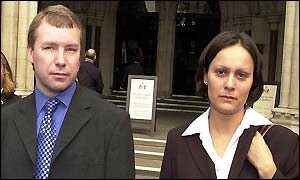
Christopher Lillie and Dawn Reed outside the High Court in 2002

In November 1998 the Review Team’s Report was published. It found that Christopher Lillie and Dawn Reed had abused as many as 65 children at Shieldfield Nursery. Lillie and Reed had had some sort of perverted sexual relationship.

Horrific sexual abuse was detailed. The “powerful” video interview of a child supposedly raped by Lillie was discussed. References were made to a wide-spread paedophile ring, the video-taping and photographing of the sexual abuse, and the depravity of the abuse. Other people who were part of the paedophile ring were hinted at.

Newspaper articles in the national and local press referred to the difficult and troubled lives of those children affected by the abuse. Further articles asked the public to help find Christopher Lillie and Dawn Reed, the “fiends” who had once again gone in to hiding.

Anyone reading the Report would have been horrified at the scale and type of sexual abuse visited on 2-3 year old children by those supposedly caring for them. And the reader would also wonder why the detailed, rigorous findings of the Report, and the evidence seen by the Review team, had not resulted in the convictions of anyone for the horrific crimes.

Dr Camille San Lazaro who "threw objectivity to the winds"

In July 2002 came the answer. The criminal process had not failed the Shieldfield Children. Rather, it had got it right. The children at Shieldfield and their parents had indeed suffered greatly, but not at the hands of Lillie and Reed, who had done nothing wrong whatsoever.

Rather, a modern-day Salem-style witch-hunt, mass hysteria, unreliable and unscientific professionals, and a catalogue of disasters had lead to the Shieldfield tragedy, in which impossible and implausible allegations came to be believed, disseminated and acted upon. Christopher Lillie and Dawn Reed were victims of the Shieldfield affair, together with the children and their families.

Lillie and Reed had sued for libel. They sued the authors of the report, Newcastle City Council for publishing it, and various Newcastle newspapers for articles written about them. Mr. Justice Eady, after a 6 month trial, found that the 4 authors of the Report has not only got the facts wrong, they had acted with malice. The judge said, “I am entirely satisfied of Mr Lillie’s and Miss Reed’s innocence.”

Each of the Claimants, Lillie and Reed, were awarded the maximum £200,000 damages each for the libel, and cleared of any wrong-doing in relation to any sexual abuse, or any of the children at Shieldfield.

How did it all start?

In April 1993, Jason Dabbs pleaded guilty to the indecent assault of children at a Newcastle Nursery and was jailed for it. Days later, the mother of “Child 22″ told the police that her 2 year old son had told her that “Chris” had hurt him while changing his nappy. Lillie was suspended, and the child was interviewed on video by the police and social workers. During the interview, the boy was specifically asked if it hurt when his nappy was changed. He said it did. He was asked if Chris had hurt him, to which he replied, “no”. He said he liked Chris changing his nappy. Child 22 had been on iron tablets for some time and was constipated, and had a long history of behavioural problems whcih had calmed down when he was in the care of Lillie and Reed.

Child 22’s mother was sure that he had been abused. She talked to other parents and told them about the “abuse” by Lillie, and made them concerned about their own children. She was told by the police in July 1993, “No bull shit. I don’t want you talking to anyone”, but by then, several other parents were looking for signs that their children had been abused. Mr. Justice Eady found that, “it has become clear with the benefit of hindsight that the mother of Child 22 is a completely unreliable “historian”. Her accounts changed radically over time” although he made it clear that he did not blame her.


The Developing Witchhunt
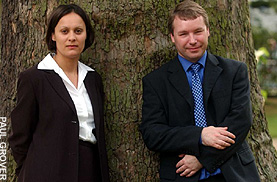
Declared innocent - Christopher Lillie and Dawn Reed

Declared innocent - Christopher Lillie and Dawn Reed

The investigation snow-balled. Meetings were held at the nursery. Children were anxiously quizzed about their time at the nursery by parents and other relatives. Police officers and social workers got more involved.

Many children were examined by Dr. Camille San Lazaro, who kept inadequate records, caused many parents to become alarmed, and whose records were often changed and exaggerated. the doctor accepted in the libel trial that her reports were sometimes exaggerated and over-stated. the judge found that her integrity and credibility were seriously damaged, and said “she was unbalanced, obsessive and lacking in judgment”, and that, “the truth is that, where physical findings were negative or equivocal, Dr San Lazaro was prepared to make up the deficiencies by throwing objectivity and scientific rigour to the winds in a highly emotional misrepresentation of the facts”.

Children were interviewed on video over a long period, often several times. An expert witness, whose evidence was accepted by the judge, said:

The interviews that I examined in the present case are among the worst that I have ever encountered. In this case, extremely young and bewildered children were brought in and interrogated (sometimes for over an hour) by one, by two and even by three interviewers. These interviewers used the full array of suggestive techniques to elicit allegations of abuse.

When the children denied that they had been abused, they were bombarded with more suggestions, they were scolded, they were threatened and they were bribed. And when some children whimpered, moaned or begged the interviewers to end the questioning, the interviewers continued. In sum, the interviews were abusive and the children were victims of the interviewers.

There were three aspects of these data that are incontrovertible: (1) these video-taped interviews provide the only opportunity for us to hear the children’s own words; (2) the children did not initially make statements that were indicative of abuse; (3) when they did make statements these were preceded by extremely suggestive techniques that render all subsequent statements unreliable

Mr. Justice Eady went through evidence in relation to the children one by one, carefully and thoroughly. He found that no child could said to have been sexually abused. Children often said that nothing had happened to them, or were coached, suggested answers, heard things from other children or their parents, or gave impossible accounts - involving children who weren’t at the nursery, or clothes the child was wearing when interviewed, or about places they could not have been to and people they could not have met. Children were being asked to give accounts of things that had supposedly happened when they were 2 years old some years later.

What the Judge Said about the Report and its Writers

The judge made a finding of “malice”, which meant that the writers could not claim the protection against libel that they otherwise could in such as report. He said that the writers, “came to distort and misrepresent the evidence against them”, that they wrote things that they all knew were untrue, that they claimed to have had open minds, but that he did not believe them, that, “their procedures were quite unsuited to performing it with any semblance of fairness or natural justice. What they did was to assemble arguments, theories and selective bits of evidence and use them to justify the assumptions they had made from the outset”.

He concluded by saying:

The Review Team chose to promulgate to the Council and to the wider public what was recognised within days (by Mr Cosgrove and Mr Marron, in particular) to be a specious and disreputable document. They must have appreciated the harm they would do to the Claimants and indeed the physical risks to which they were choosing to subject them. But they were left to learn about these horrendous allegations for the first time through saturation media coverage. That lacked not only fairness but also humanity. Yet the Team even made the false claim that they had been given advance warning of the allegations and findings and a chance to respond.

Why call it a witch hunt?

It might seem different. After all, we know witches don’t exist, but that child abusers certainly do.
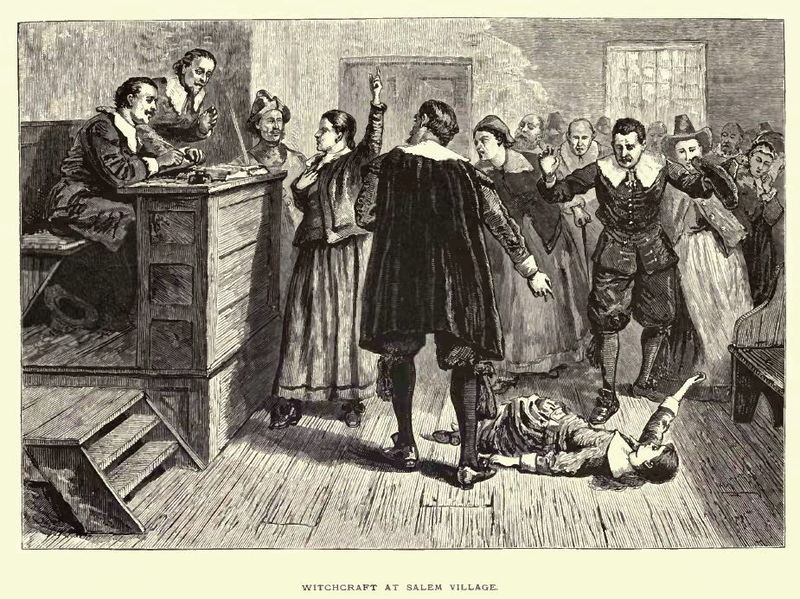
Not all that different - the Salem Witch Trials

Not all that different - the Salem Witch Trials

This is looking at it the wrong way. After all, in Salem they knew witches existed. They had to go and find them, that was all. In the present case, the members of the Review Team “knew” that Lillie and read were abusers. If there were awkward facts which pointed the other way, they missed them out of the report or claimed the opposite.

If a child said he had been abused, no matter how inaccurate or incredible or prompted his account was, they believed it. If a child said nice things about Lillie or Reed, the Team thought it was evidence that the children had been frightened into silence by their abusers.

The fact that not one child made any spontaneous contemporary complaint didn’t bother the writers. The leading questions in the interviews of the children was denied in the report - an outright lie.

It took 9 years for Christopher Lillie and Dawn Reed to establish their innocence. Children were treated in a way that turned out to be abusive, but by social workers and police officers.

So if you read about King James I’s witchfinder, don’t feel smug. It happened here (and in the USA, Germany, and many other countries) over the last 20 years, too.

You can read Mr Justice Eady’s full judgment here, and an article by the man who started helping Lillie and Reed after the report was published here.

Royal Navy Rum - issued daily to sailors 1655 to 1970

By Blog author, February 8, 2010 2:01 am

Alcohol and the Royal Navy often seem to go together - there are the nautical phrases for the time in the evening when a drink is OK, “the sun’s over the yardarm”, and having one too many can lead to a person being described as “three sheets to the wind”.

And, of course, there’s the old sea shanty, “What Shall We Do With the Drunken Sailor?”

Even given all that, though, it might come as a surprise to learn that the Royal Navy was issuing daily rum rations to all enlisted men (even those in nuclear submarines) until 1970.

Up Spirit ceremony on HMS Endymion, 1905

Up Spirit ceremony on HMS Endymion, 1905

After “Black Tot Day”, the final rum ration was replaced - by 3 cans of daily beer, instead……

Before Rum - Beer to combat foul water

Like pretty much everyone else, before 1655, sailors drank mostly small beer, or ale.

It was healthier than drinking water which was too often contaminated. Casks of drinking water on board ship quickly got stagnant and nasty, and no-one wanted to drink it.

But on longer voyages, the stuff didn’t keep that well. So the Senior Service needed a better solution - what to give sailors to drink?

The Start of Rum Rations

Sailors being issued with rum in Portsmouth in 1933

Sailors being issued with rum in Portsmouth in 1933

England conquered Jamaica in 1655, and an enterprising local captain started issuing a daily ration of rum to his sailors, instead of the official Royal Navy beer ration of a gallon (!!) a day.

The Royal Navy took over officially in 1740. From that date, each sailor in the Service was issued with half a pint of strong rum each day, half at noon, half at sunset. Before and after a battle, double rations were issued.

It was issued neat for a few years, but (oddly enough) some sailors stored up their rations, and then got completely blotto on them.

So from 1756, the standard “grog” rum was issued - 2 parts water to 1 part rum, mixed with lime or lemon juice, and cinnamon.

It’s thought that the nickname “limey” comes from this practice of adding citrus juice to the rum, a habit which combated scurvy.

In 1850, the ration was reduced to 1/4 pint (5 fluid ounces) and then to 1/8th pint (2.5 fluid ounces).


The Up Spirit Ritual

The issuing of the rum ration became an elaborate ceremony. At 11am, the boatswain’s mate piped the tune “Up Spirits”, and a procession ladled out the rum, into portions for more senior NCOs, and the rest mixed with water (etc) for the ratings.

At midday, the boatswain’s mate piped the tune, “Muster for Rum”, and the crew came and got their half-pints of grog.

In the 18th and 19th centuries, the officers’ rum rations were accompanied by toasts - first the Loyal Toast (to the King or Queen) followed by a different toast for each day of the week:

Monday, “Our ships at sea”

Tuesday, “Our men”

Wednesday, “Ourselves”

Thursday, “A bloody war, and quick promotion”

Friday, “A willing soul and sea room”

Saturday, “Sweethearts and wives, may they never meet”

Sunday, “Absent friends, and those at sea”

See the HSM Hood website for more pictures of the daily Up Spirits ritual in the 1930s

Black Tot Day - the End of the Rum Ration

 Black Tot Day on board HMS Phoebe

Black Tot Day on board HMS Phoebe

On 31st July 1970, the last rum was issued to ratings - on a day known as “Black Tot Day”. The Portsmouth Evening News said:

……sailors said farewell to the last issue of Nelson’s Blood, (as rum was known in the navy), by conducting mock funerals and wearing black armbands…The annual Christmas pudding stirring ceremony in HMS Bellerophon was brought forward today so that the usual four pints of rum could be included in the 150lb mix

Different ships carried out different farewell ceremonies. One ship in the Arabian Gulf buried their last barrel, and erected a headstone which said, “Good and Faithful Servant” on it.

HMS Dido put the last tot in a bottle with a note inviting the finder to drink to the health of the Royal Navy, and threw it overboard.

British Navy Pusser’s Rum, on sale since the 1970s, is the Admiralty’s mixture of 6 different rums, as served on board ship for centuries.

American and Empire Soldiers in England during the First World War - Picture Gallery

By Blog author, February 7, 2010 4:29 am

As well as British, French, German, Italian and Russian soldiers, men from all over the world fought in the First World War.

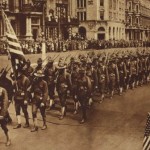
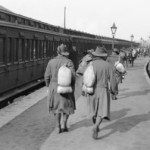
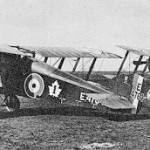
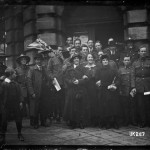
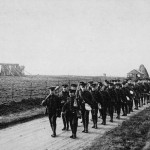
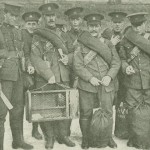
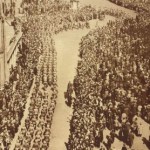
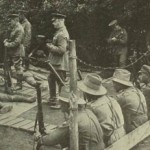
This collection of photographs (all in the public domain) show troops from America, Canada, New Zealand, Australia, and India, in the UK before leaving for the fighting front - mostly in France, but others went to the other fronts, too.

Jewish Blood Libel: Persecution & Greed in Medieval England

By Blog author, February 2, 2010 1:29 am

The English origins of the blood libel

“Little Saint Hugh of Lincoln” was a popular medieval saint, supposed to have been the victim of a ritual, Jewish murder in the 12th century.

The terrible medieval blood libel against Jews, which started a wave of persecution, torture, death, and exile, got off to a less than glorious start in Norman England.

In later times a blot on Russia and Eastern Europe, and in modern times, also shame on the Muslim World, this long-lasting accusation, born from anti-semitism, started in Norwich and Lincoln, in the mid 12th century.

What is the Jewish Blood Libel?

A 16th century French woodcut, showing a Jew calling the devil forth from a vat of Christian blood

A 16th century French woodcut, showing a Jew calling the devil forth from a vat of Christian blood

The exact details varied from case to case, but there were many elements common to all or most of the blood libel allegations.

They involved the ritual human sacrifice, and slaughter for religious Jewish practice of a Christian, in sadistic ceremonies.

In general, a child, usually a pre-adolescent boy, was said to have been abducted or seduced and coxed into a Jew’s house.

He was then tortured, often circumcised, sometimes with a parody of cruxifiction, and had his blood drained for, use in ritual religious foods.

The accusations were often followed by an orgy of violence against Jews who lived anywhere near the town where the death occurred.

It was a rather handy way for Kings and local power-brokers to get their sticky fingers on Jewish money and assets - either by taking over the estates of the “criminals”, or by demanding what was, in effect, protection money.

The fact that Jews are particularly careful to avoid eating even animal blood - draining it from animals as they are killed, and soaking meat cuts to remove it - appears to have passed the blood libel mobs by.

After the first blood libels circulated in England, the practice spread all over Europe, and to Russia and the Muslim world.

The First Accusation in England - William of Norwich

A 15th century painting depicting William of Norwich

A 15th century painting depicting William of Norwich

William of Norwich was born in about 1132AD. He lived in the town for his whole life, and died at the age of about 12, in 1144.

William was an apprentice tanner, and had business dealings with Norwich’s Jewish population. Shortly before he vanished, he was seen visiting the house of a Jewish family with whom he was acquainted. He was murdered, and his body later found and buried in a local graveyard.

There followed accusations against Norwich’s Jews, and Thomas of Monmouth, a Benedictine monk in Norwich, wrote a book called The Life and Miracles of St. William of Norwich in 1174.

He was encouraged in this by the Bishop of Norwich, William De Turbeville, who seems to have seen great potential in establishing William’s tomb as a pilgrimage site. Places which became popular with pilgrims could rake in substantial amount of cash, and other valuables, left as offerings to the saints.

It doesn’t appear that William was ever actually made a saint by the Church, although he was referred to locally, in Norwich and Norfolk, as Saint William.

Blood Libel leading to Sainthood - Little Saint Hugh of Lincoln

Little Saint Hugh of Lincoln being enticed in Copin's house

Little Saint Hugh of Lincoln being enticed in Copin's house

This blood libel was a grander and far more damaging affair. Hugh of Lincoln was an 8 or 9 year old boy, the son of a local woman called Beatrice.

Hugh vanished at the end of July, 1255. His body was found roughly a month later, in or near the property of a Lincoln Jewish man, called Copin, Kopin, Joscefin,or Jopin.

A local priest called John of Lexington saw an opportunity, and under threat of torture, Copin “confessed” that he and a group of other Jews from both Lincoln and other towns had gathered together for the ritual torture and sacrifice of a Christian boy.

Copin was promised a pardon for his confessing and implicating other Jews, but King Henry III arrived in Lincoln in October, and ordered that Copin be dragged around the city tied to a horse, and then executed.

The Kings of England “owned” all English Jews, and could tax them freely and more heavily than non-Jewish, Christian subjects.

Earlier in 1255, King Henry III had sold the English Jews to his brother, Richard Earl of Cornwall. But he realised that, as King, he was still entitled to the proceeds of the estates of those Jews convicted of serious crimes.

About 100 of Lincoln’s Jews were dragged off to the Tower of London. At least 20 of them were executed, and their property forfeited to the Crown, before the rest were pardoned and allowed home.

Lincoln Cathedral (West Front) This photo is in the public domain

Unlike William of Norwich, it appears that Hugh of Lincoln did actually become a Catholic Saint. His feast day was on 27th July each year.

Not long after his death, his body was translated to Lincoln Cathedral. Above the stone tomb, a shrine was put up to Little Saint Hugh. Miracles were attributed to the intercession of Little St Hugh, and he was a popular saint.

The coffin was opened during restoration work in 1790, and found to contain a boy’s skeleton, approximately 3.5 feet long.

St Hugh of Lincoln was also a popular saint, but a different man. He was an adult when he died, and was Bishop of Lincoln.

Unless I’ve missed it, Lincoln Cathedral’s otherwise interesting website doesn’t mention the whole Little Saint Hugh thing at all, but there are lots of references to the (adult) St Hugh.

Little Saint Hugh’s legacy

The shrine above Little Saint Hugh's tomb, in a 17th century illustration

The shrine above Little Saint Hugh's tomb, in a 17th century illustration

The story was widely-known and repeated. Geoffrey Chaucer wrote about Little St Hugh in The Prioress’ Tale, one of the Canterbury Tales. The passage reads:

O yonge Hugh of Lyncoln, slayn also

With cursed Jewes, as it is notable,

For it is but a litel while ago,

Preye eek for us, we synful folk unstable

A (rough) translation into modern English, by me and not to be relied upon as gospel:

Oh young Hugh of Lincoln, also slain

By accursed Jews, as is known well,

For it was but a little while ago

Pray also for us, we unstable, sinful folk

In 1955, the Lincoln Cathedral (since the Reformation, an Anglican foundation) put up a sign next to Little St Hugh’s tomb, which says:

Trumped up stories of “ritual murders” of Christian boys by Jewish communities were common throughout Europe during the Middle Ages and even much later. These fictions cost many innocent Jews their lives. Lincoln had its own legend and the alleged victim was buried in the Cathedral in the year 1255.

A medieval blood libel fresco in St Paul's Church in Sandomierz, Poland

A medieval blood libel fresco in St Paul's Church in Sandomierz, Poland


Such stories do not redound to the credit of Christendom, and so we pray:

Lord, forgive what we have been,
amend what we are,
and direct what we shall be.

Other Examples of Medieval English Blood Libels against the Jews

There were other, similar accusations in towns and cities across England:

  • Saint Harold of Gloucester - killed in a blood libel incident in Gloucester in 1168. His feast day was March 25th
  • Robert of Bury -the supposed victim of Jewish ritual sacrifice in Bury St. Edmunds, in 1181. On Palm Sunday in 1190, there was a mob attack on the town’s Jews. 57 were killed, and the rest banished from Bury.
  • Unknown boy - another blood libel accusation, in Devizes, Wiltshire, in 1892.

The Frost Fairs: the frozen River Thames in London

By Blog author, January 10, 2010 3:43 am

The Frozen Thames in London - an Introduction

A woodcut showing the medieval London Bridge and Frost Fair on the Thames, 1683

A woodcut showing the medieval London Bridge and Frost Fair on the Thames, 1683

Between 1400 AD and 1814, the last time it happened, the River Thames in London froze over 26 times. And when it froze solidly, Londoners made the most of it, and the “Frost Fairs” developed.

The tidal, somewhat salty Thames is a deep, fast-flowing river today, but before the Old London Bridge was demolished in 1831, the river’s waters were pooled slightly behind the medieval arches, which probably helped the ice take hold.

It was also the time known as the “Little Ice Age”, when winters were colder and more severe than they have been since 1800 or so.

The huge, medieval bridge, with houses and shops above the numerous archways, is shown in the background of the woodcut to the right of this text, depicted during the Frost Fair of 1683.

The text accompanying the woodcut says:
An Exact and lively Mapp or Representation of Boothes and all the variety of Showes and Humours on the ICE of the River of THAMES by LONDON During that memorable Frost in the 35th yeare of the Reigne of his sacred Maj King Charles the 2nd

The embankments had not yet been built, either, and so the River Thames was wider, shallower, and probably a little slower.

The Frozen Thames in the 16th century

The Thames froze over several times in Tudor England. Henry VIII is known to have travelled from Whitehall, next to Westminster, to Greenwich by sleigh, along the River Thames, in 1536. Greenwich was one of Henry’s favourite palaces; he married there more than once, and his daughter Elizabeth I was born there later in 1536.

In 1564, Elizabeth I practised her archery on the frozen Thames, and boys and men played football on the ice.It was said of this winter:

On the 21st of December, began a frost, which continued so extremely that on new year’s eve people went over and along the Thames on the ice from London Bridge to Westminster. Some played at the foot-ball as boldly there as if it had been on the dry land; diverse of the court shot daily at pricks set up on the Thames; and the people, both men and women, went on the Thames in greater numbers than in any street of the city of London.

On the 31st day of January, at night, it began to thaw, and on the fifth day was no ice to be seen between London Bridge and Lambeth, which sudden thaw caused great floods and high waters, that bare down bridges and houses, and drowned many people.

The development of Frost Fairs into full-blown parties

The first frost fair, in terms of full-scale activity and commercial stalls and sports took place in 1608. It was a cheerful and spontaneous affair.

A woodcut showing the Thames Frost Fair  in 1683/1684

A woodcut showing the Thames Frost Fair in 1683/1684

The “Long Freeze” or “Great Freeze” of 1683/4 was one of the coldest-known English, and European, winters. The Thames froze solidly, and the ice was up to a foot deep. The frost began 6 weeks before Christmas, and lasted into February.

Streets of stalls and booths stretched from bank to bank; all London’s normal entertainments made their way on to the river.

A whole ox was roasted at Hungerford Steps, bear-baiting and and puppet-shows were held on the ice. Skating and “chair-pushing” events were also set up.

A pamphlet published about the Long Frost included this passage:

A whole street of booths, contiguous to each other, was built from the Temple Stairs to the barge-house in Southwark, which were inhabited by traders of all sorts, which usually frequent fairs and markets, as those who deal in earthenwares, brass, copper, tin, and iron, toys and trifles; and besides these, printers, bakers, cooks, butchers, barbers, coffee-men, and others, who were so frequented by the innumerable concourse of all degrees and qualities, that, by their own confession, they never met elsewhere the same advantages, every one being willing to say they did lay out such and such money on the river of Thames.

John Evelyn, a diarist, said that:

Frost Fair Mug 1683/4

Frost Fair Mug 1683/4

Coaches plied from Westminster to the Temple, and from several other stairs too and fro, as in the streets, sleds, sliding with skates, bull-baiting, horse and coach races, puppet plays and interludes, cooks, tippling and other lewd places, so that it seemed to be a bacchanalian triumph, or carnival on the water

The mug shown in the picture to the right of this text is tiny, less than 2.5 inches high. Engraved on the base are the words, “Bought on ye Thames ice Janu: ye 17 1683/4″.

It is in the Victoria and Albert Museum in Kensington.

It is astonishing that something so small and delicate lasted to be put in a museum!

The Great Frost of 1709, probably Europe’s coldest winter for 500 years, saw another large-scale frost fair.

Not only rivers, but huge chunks of the North Sea, froze during the terrible cold of the winter, and in France, an estimated 500,000 people died of starvation and malnutrition later in the year. There is a fascinating article from the New Scientist about this winter, called 1709: The year Europe froze.

A London paper said:

The Thames seems now a solid rock of ice; and booths for sale of brandy, wine, ale, and other exhilarating liquors, have been for some time fixed thereon; but now it is in a manner like a town; thousands of people cross it, and with wonder view the mountainous heaps of water that now lie congealed into ice.

On Thursday a great cook’s-shop was erected, and gentlemen went as frequently to dine there as at any ordinary. Over against Westminster, Whitehall, and Whitefriars, printing presses are kept on the ice.

The last River Thames Frost Fair

The Frost Fair on the River Thames in London, 1814, by Luke Clenell

The Frost Fair on the River Thames in London, 1814, by Luke Clenell

The last proper freezing of the River Thames in London took place in 1814.

The frost set in at the start of January, and by the end of the month, the River was frozen solid - an elephant was led across the Thames by Blackfriars Bridge to demonstrate the safety of the ice.

Hoardes of traders and entertainers rushed to set up shop, and the fair was in full-swing. It was shorter than many, as the solid ice lasted only a week.

Writing 20 years later, Charles Mackay said of the 1814 fair:

Each day brought a fresh accession of pedlars to sell their wares, and the greatest rubbish of all sorts was raked up and sold at double and treble the original cost.

The watermen profited exceedingly, for each person paid a toll of twopence or threepence before he was admitted to the fair; and something also was expected for permission to return. Some of them were said to have taken as much as six pounds in a day.

Many persons remained on the ice till late at night, and the effect by moonlight was singularly novel and beautiful. The bosom of the Thames seemed to rival the frozen climes of the north.

Since 1814

Ice on the River Thames in 1895

Ice on the River Thames in 1895

There has, of course, been ice on the River Thames since 1814 - what has not happened since then is the absolute freezing of the water, thick enough to allow lots of activity to take place on the ice.

The photograph to the right of this text shows ice in 1895, with the newly-constructed Tower Bridge in the background.

It looks pretty uneven, and not much fun to walk on!

Cressing Temple: Visiting Knights Templar property in England Today

By Blog author, January 5, 2010 3:37 am

Introduction to the Knights Templar

Plan from excavations in the late 1990s at Cressing Temple

The Knights Templar, the fabled, fantastically rich, and powerful organisation that rose spectacularly in the Middle Ages, fell as dramatically.

The “Poor Fellow-Soldiers of Christ and of the Temple of Solomon” order, known more commonly as “The Knights Templar”, was founded in Jerusalem in 1119 AD to protect pilgrims bound for the Holy Land, and dissolved by the French King and the Pope in 1312.

In just under two centuries, the Templars became powerful, important, and famous as an order of fighting monks. They were far from the only military knights who were also subject to a monastic rule, but they became (and remain to this day) the best known.

Everyone loved them, from the Pope, Kings and Princes to the peasants and labourers, and their success and visibility was unparalleled.

Their fall 200 years later was equally dramatic, and the Papacy was forced by the French King (who was, in effect, in control of the Pope) into eliminating them.

Many of the Templars were burned alive, particularly in France. In other countries, such as England, most were allowed to go quietly on their way, many joining other orders of monks.

The cellar at Cressing Temple, from the Templars' time, uncovered during excavation works

The cellar at Cressing Temple, from the Templars' time, uncovered during excavation works

Visiting Knights Templar sites in England today

Many of the biggest and best-known Templar properties can be indentified and visited, but the extent of the remains of Templar buildings varies significantly.
There are a number which have substantial and significant sites still, and others where only the name survives today.
This is the first in a series of posts about visiting Knights Templar property in England, and starts with the Essex site of Cressing Temple.

Cressing Temple - significant remains and buildings survive

Cressing Temple is in Essex, England. It’s a scheduled ancient monument, owned by Essex County Council, and open to the public. A lot is left, and it’s a great place to visit to get a sense of the Knights Templar organisation and property.

It was the largest and most significant of the properties the Knights Templar owned in Essex, and was in the charge of a “Preceptor”.

This was the title of the Knight who had charge of an area and a number of monks under him; he was answerable only to the Grand Master of the Order.

Cressing Temple was given to the Templars in 1137 by Matilda, wife of King Stephen, not the rival claimant to the throne, the Empress Matilda.

The astonishing buildings at Cressing Temple, standing today

Plan showing the timber structure of the Wheat Barn at Cressing Temple.

Plan showing the timber structure of the Wheat Barn at Cressing Temple.

Two great barns were built by the Templars at Cressing. The first is now called the Barley Barn, and is thought to have been built some time around 1210 A.D.

The Wheat Barn was built in about 1260 to 1270 A.D. It is built directly on top of a Bronze Age settlement.

The Barley Barn is an immense structure built from oak, and was made from an estimated 480 oak trees. Tree science, dendrochronology, has dated the felling of these trees from between 1205 and 1235.

The Barn was originally larger even than it is today, but it seems to have been repaired later and made smaller at that time. It now measures about 36 metres long by 13½ metres wide.

Although it’s been repaired over the years, the original structure of the Barn still holds it up today. The arcade posts and main ties are the ones built by theTemplars.

The Barley Barn at Cressing is the oldest timber framed barn still in existence in the world.

The Wheat Barn is larger, 40 metres long and 12½ metres wide. It was built from 472 different oak trees, and there are identical trusses with braces meeting at a scissor above the collars.


Records and research into Cressing Temple

The Templar-built well at Cressing Temple

The Templar-built well at Cressing Temple

More is known about Cressing Temple than many Templar foundations because inventories made by both the Knights Templar and Knights Hospitaller have survived.

There has also been extensive archaeological research, with Essex County Council excavating the site between 1987 and 1996.

The archaeological excavations have shown that when the Templars took over the land they cleared it, and set up drainage systems, and started to build.

Evidence has been found of post holes, timber slots, gravelled surfaces outside, and latrine pits. The foundations of an original timber chapel built in about 1145 was discovered. This was replaced by a stone chapel a few years later.

The Templars also dug a very deep well, about 45 feet deep. It was lined with Reigate stone. There is also evidence that they filled in some existing ditches, and dug new ones to drain the land more efficiently.

The Well House was only built at the end of Victorian times, but the well itself is undoubtedly a Templar structure.

There is evidence from Carbon 14 dating to show that trees were cut down partly in order to make room for the buildings, and partly in order to provide the timber to build them.

There is also what appears to be a clay quarry which may have been used for tiles for the floors of the barns and other buildings.

The Wheat Barn, at Cressing Temple

The Wheat Barn, at Cressing Temple

The quarry appears to have been used as a rubbish dump and filled up by the Templars in the years after it was opened.

Three large ponds were also dug and presumably stocked with fish. The Knights Templar, like other monastic orders, did not eat meat many days of the year and ate fish instead. It was common for large houses or organisations to have their own fish ponds.

A very complete inventory from 1313 mentions a church, two chambers (almost certainly used as bedrooms) a great hall, a pantry, a kitchen, a buttery, a larder, bakehouse, brewhouse, dairy, granary, smithy, a well, and two barns.

The Templar holding at Cressing Temple was originally about 14,000 acres. It was very fertile land, good for agriculture, and the produce could be easily moved by river.

The Templars employed over 160 tenant farmers on the Cressing Temple site, and also established a market.

In 1309, before the estate was handed to the Knights Hospitaller the Cressing Temple was recorded as having a mansion house, bakehouse, brewery, dairy, granary, smithy, gardens, a dovecote, chapel, cemetery, watermill and a windmill.

After the suppression of the Order, the Cressing Temple passed to the Knights Hospitaller in 1313.

Visiting Cressing Temple

The Barley Barn at Cressing Temple

The Barley Barn at Cressing Temple

Cressing Temple’s address is Witham Road, Cressing, Braintree, Essex, CM77 8PD.

It’s about 50 miles from central London, and 4 miles from the nearest railway station, Witham (trains take about 45 minutes from London Liverpool Street station).

From April to September Cressing Temple is open from 10am - 5pm Sunday to Friday, in March and October from 10am - 4pm Sunday to Friday, and from November to February, 10am and 3pm Monday to Friday.

The site’s details, opening hours, and travel directions can be found here.

Speakers’ Corner and Protests in Hyde Park, London

By Blog author, December 15, 2009 4:56 am

Introduction

Map of Hyde Park, showing Speakers' Corner at the north-east corner (top right)

Map of Hyde Park, showing Speakers' Corner at the north-east corner (top right)

Hyde Park is one of the glorious Royal Parks in London.

Together with its neighbouring parks, Kensington Gardens and St. James’ Park, Hyde Park’s 350 acres provide greenery, sports facilities, plants, trees, flowers, birds and space for Londoners and visitors to London.

As well as tennis, golf putting, cycling and skating, there are also boats and rowing boats on the Serpentine.

Hyde Park is also a traditional site of free speech, political protests, and marches, and has been for centuries.

If a major political movement existed in the last 300 years, it held rallies or marches and made speeches in and around Hyde Park.

This post is about those marches and protests, and about “Speakers’ Corner”, at the edge of the park.

Speakers’ Corner

Hyde Park corner in 1842

Speakers’ Corner is centred on the area at the far north-east of Hyde Park, near Marble Arch.

It is a place where anyone can stand up on his hind legs and talk about whatever he pleases, providing it does not incite violence, or encourage terrorism/

At any time on a weekend or public holiday, there are several speakers at Speakers’ Corner.

At pretty much any time when it is light, there is likely to be someone giving forth his (and it is usually men, rather than women) views on whatever it is he is exercised by.

Karl Marx, Lenin, George Orwell, and William Morris all spoke frequently at Speakers’ Corner.

People turn up and talk about all sorts of things, although there are also people who attend regularly to heckle.

The Chartists Movement and Hyde Park

A cartoon from Punch about the Chartist demonstration, in which a special constable says, “Now mind, you know – if I kill you, it’s nothing; but if you kill me, by jingo it’s murder”

A cartoon from Punch about the Chartist demonstration, in which a special constable says, “Now mind, you know – if I kill you, it’s nothing; but if you kill me, by jingo it’s murder”

The Chartist Movement did a lot of protesting in Hyde Park.

Chartism was a political movement between 1837 and 1850, and the six main aims of the movement as set out in 1838 were that:

  • (all men over 21 should be able to vote;
  • electoral districts should be the same size in terms of number of people;
  • all voting should be by secret ballot;
  • there should be no need for a person to own property in order to be elected to Parliament;
  • Members of Parliament should be paid so that people other than the independently wealthy could become MPs;
  • Parliament should hold annual elections.

Although derided and disliked by the powers at the time, the Chartist’s aims have all been achieved apart from annual elections.

The Chartist movement used Hyde Park as a point of assembly for many protests on behalf of their campaign.

Riot in Hyde Park, 1855

There was a riot in 1855 when Parliament introduced the Sunday Trading Bill.

This made it unlawful for most goods to be bought or sold on a Sunday, other than fresh food.

It tended to irritate people who worked the other six days of the week and wanted to do their necessary shopping on Sunday.

Karl Marx decided these riots were the beginning of the English Proletariat Revolution; in which he was entirely wrong.

The Reform League and the Hyde Park Railing Affair

Danny Lambert from the Socialist Party of Great Britain, at Speakers' Corner in Hyde Park

Danny Lambert from the Socialist Party of Great Britain, at Speakers' Corner in Hyde Park

The Reform League was established in 1865, and wanted universal male suffrage and secret ballots for every vote.

There was a huge meeting of supporters of the Reform League in Hyde Park on 23 July 1866.

The Home Secretary declared it to be an illegal meeting and issued a Notice, but the Reform League pressed ahead regardless. The procession started from the Reform League’s headquarters in Adelphi Terrace, and went up Regent Street.

When the group arrived at Hyde Park, the Marble Arch entrance, 1,500 police constables guarded the Park’s gates. The gates were chained and entry to Hyde Park was refused.

Determined to enter the Park, several of the protesters pushed the railings around the gate, and the railings fell in. Protesters launched themselves into Hyde Park despite the efforts of the police to prevent them from doing so.

Two other parts of the demonstration broke into the Park at the same time, one from Knightsbridge, and one from Park Lane.

As well as the protesters themselves, a lot of people who had been standing and watching the protest decided that the closing of Hyde Park was unreasonable and attempted to join in the storming. An estimated 200,000 people managed to get into the Hyde Park.

The police called for army support, and the Horse Guard Blues arrived. The soldiers did not intervene despite the police being stoned by the group.

The meeting was held in Hyde Park as planned, and another meeting was planned for the next evening in Trafalgar Square. The meeting ended peacefully as did the following evening’s meeting in Trafalgar Square.

The “Hyde Park Railings Affair” was reported widely in the press and increased support for the Reform League immensely. Generally, the Reform League was a middle class movement, and violence was strongly discouraged.

The Reform League held another demonstration the following year, on 6th May 1867. The government banned the meeting once again, saying it was illegal, but backed down when the Reform League continued.

The Reform League’s effort culminated in the passing of the Reform Act 1867 which extended the franchise, but did not make voting universal even for the male population.

Under the Parks’ Regulation Act 1872, the granting or denying of permission to hold public protests or meetings was delegated to the Royal Parks Authority.

Speakers’ Corner is the traditional site for such speeches.

Modern protests and marches in Hyde Park

The Countryside Alliance held a big march through London on 1st March 1998, the Countryside March, in which 285,000 people passed through Hyde Park.

This was followed by a Countryside March, the “Liberty and Livelihood March“, on 22nd September 2002, when 408,000 people marched through London including Hyde Park, the largest civil liberties march in modern history.

There was a massive demonstration in 2003 against the war on Iraq, which the Park authorities tried to prevent. They backed down.

The Countryside Alliance, who organised the largest march and protest in modern British history, has a website which can be found here.

The Berlin Airlift and the Royal Air Force

By Blog author, May 13, 2009 5:15 pm

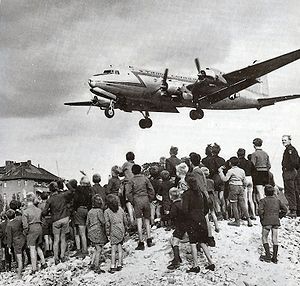
A plane landing at Templehof Airfield in late 1948Yesterday, 12th May, was the 60th anniversary of the ending of the Berlin blockade by Stalin, and therefore the end of the absolutely incredible Berlin airlift.

Stalin blockaded Berlin in June 1948, after Winston Churchill had already spoken with misgiving of the “Iron Curtain falling across Europe”.

After the end of the Second World War, Germany was occupied by the Allied Power - the United Kingdom, the United States, France, and the USSR. Each power had a chunk of Germany, and also a chunk of Berlin - but Berlin was cut off from the rest of what would become West Germany by the future East Germany - it was surrounded.

Stalin got unco-operative. His aim from VE Day (Victory in Europe Day) in 1945 was to encourage, push and oblige the other Allied powers out of the whole of Germany. He wanted to have a united country, which was Communist and under his control, much as Poland and Czechoslovakia were.

In the first major crisis of the Cold War, therefore, Berlin was targeted. Communist candidates in the elections of 1946 were overwhelmingly voted against - Berliners had only too recent memories of the sustained campaign of rape and theft carried out by the USSR’s Red Army.

Starting in March 1948, the USSR began to insist on prior clearance and permits for any barges, trains or lorries crossing the Soviet Zone, including those in Berlin. They also started searching all Allied transport, checking passports, and generally making themselves as awkward as possible.

Berlin was the first stage in Stalin’s plan to grab all of Germany. USSR foreign minister Molotov (who had signed the Molotov-Ribbentrop pact with Hitler in August 1939) said, “What happens to Berlin, happens to Germany; what happens to Germany, happens to Europe.”

The crisis came to a head in June 1948, when the USSR stopped all land-based transport into and out of Berlin, from and to the other Allied sectors.

The Allied forces were in trouble. British officers had calculated that Berlin needed 1,500 tonnes of food and 3,500 tons of coal, petrol and oil a day to keep it alive, a total of 5,000 tonnes per day. The Royal Air Force had, at the time, a daily airlift capacity of 400 tonnes, which could be upped to 800 tonnes fairly easily with the transfer of additional planes from the UK, and the US airforce 300 tonnes per day.

The Berlin airlift started on 28th June 1948. The first week, only 90 tonnes was flown in, and the second week, 900 tonnes. But the operation built up steam fast - by the end of July, 3,400 tonnes a day was being flown in, and by September, the necessary 5,000 tonnes a day.

The Soviets tried their best to derail the operation. They shot near (but not at) Allied planes, and flew their own planes in the way (a couple of crashes were caused when they got too close). They also initiated a sustained programme of radio propaganda, trying to persuade Berliners that the airlift was hopeless and offering incentives for the people to move to Soviet areas.

The original 5,000 tonnes per day depended on a very limited diet, intended to be short-term, and summer weather. By the winter, the daily lift necessary was 11,000 tonnes. The Allied powers, joined now by France, were determined not to back down, and more planes and crews were brought in.

By April 1949, the daily supply into Berlin was actually greater than had arrived by train before the start of the blockade.

The Soviets had been embarrassed, and on 12th May 1949, lifted the blockade. The airlift continued for some time, however, as the Allied Powers didn’t trust Stalin further than they could throw him, and wanted to build up large reserves of food and fuel in Berlin.

100 people died during the airlift, including 40 RAF pilots.

The scale of the operation was absolutely amazing. At the height of the airlift, a plane landed every 90 seconds, and near misses were alarmingly common.

It was a real achievement, and prevented a significant expansion of Soviet power throughout Europe.

You can read a fascinating account of RAF pilots’ experiences of the Berlin Airlift here, in this BBC article, “Bitter-sweet memories of Berlin Airlift

Panorama theme by Themocracy