Category: Kings and Queens

Henry VIII’s Wives: Catherine of Aragon’s family and childhood

By Blog author, April 26, 2010 2:32 am

Catherine of Aragon (1485 to 1536)was King Henry VIII’s first wife - out of six. She was his wife for 24 years, but ultimately fell foul of Henry’s obsession, that he father a legitimate son.

This post, the first of a series about Henry’s wives, is not about the political and religious context of Catherine and Henry’s marriage, but about Catherine of Aragon herself - her family, her education, and her appearance.

What Catherine of Aragon looked like

Catherine did not look like a modern view of a typical Spanish girl. She was not dark-haired or olive-skinned. Like her sisters and brother, she seems to have had reddish-blonde hair, and fair skin. She also had bright blue eyes.

Portrait of Catherine of Aragon when she was Prince Arthur's widow, by Michel Sittow

Portrait of Catherine of Aragon when she was Prince Arthur's widow, by Michel Sittow

Catherine was also small - as a girl, both short and petite, although (not surprisingly) she put on a considerable amount of weight because of repeated pregnancies.

The English Tudor ideal of a beautiful woman was one who was fair-haired and fair-skinned, and Catherine seems to have been attractive and a pretty girl and young woman.

The portrait to the right of this text shows Catherine as a young woman, after she was widowed by the death of Prince Arthur, older brother of Henry VIII. She was therefore about 17 when it was painted.

Further down in this post, there are portraits of Catherine’s mother, Isabella, and one of her sisters, Joanna, both of whom looked very similar to Catherine, particularly in colouring.

Daughter of the Catholic Kings

Catherine’s parents were both monarchs in their own rights - Ferdinand (1452 to 1516) was King of Aragon, and Isabella (1451 to 1504) was Queen of Castile.

Ferdinand of Aragon, Catherine of Aragon's father, painted by Michel Sittow

Ferdinand of Aragon, Catherine of Aragon's father, painted by Michel Sittow


The couple, awarded the title of “The Catholic Kings” by the Pope, ruled together over the greater part of the Iberian peninsula, and completed the reconquista, or wars against the Moors.

At the conclusion of the reconquista in 1492, there were no Islamic states based in Spain for the first time for over 500 years.

They also expelled the large, successful and well-integrated Jewish communities throughout their realms.

Ferdinand and Isabella married in 1469, aged 17 and 18 respectively, and established co-sovereignty over the two Kingdoms, with both their heads appearing on coins, both signatures on royal proclamations and charters, and both costs of arms equally displayed.

Isabella made sure that she did not submit (as Ferdinand wanted) to being a royal consort, she was Queen in her own country.

Isabella travelled with her armies, camped with them, even when heavily pregnant, and saw herself, it appears, as the religious warrior Queen.
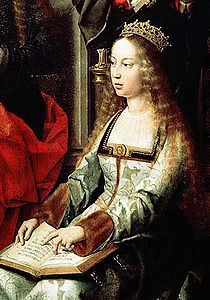
Isabella of Castile, Catherine of Aragon's mother

Isabella of Castile, Catherine of Aragon's mother

Machiavelli had a particular admiration for Ferdinand, saying:

From being a weak King he has become the most famous and glorious King in Christendom. And is his achievements are examined, they will be found to be very remarkable

Birth and siblings

Catherine was the youngest of 5 children who survived to adulthood. The older four, in order, were Isabella, Juan (the only boy), Juana, and Maria.

Isabella (1470 to 1498)

In April 1490, aged 19, Isabella married Prince Alfonso of Portugal in Seville. He died the following year, and she returned home to her parents before marrying Manual I of Portugal, who was Alfonso’s uncle. She bore him a son, Miguel, in 1498, but died in childbirth, Miguel himself died aged 2.

Juan or John (1478 to 1497)

Juan / John married the Archduchess Margaret in 1497, and died 6 months later. His posthumous son was still born also, meaning that the position of heir to Castile and Aragon passed to his older sister Isabella, then her son Miguel, then to his younger sister Joanna.
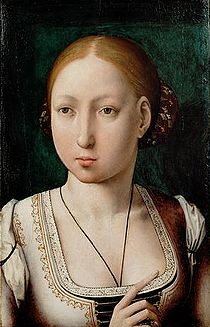
Joanna the Mad, Catherine of Aragon's sister, painted by Juan de Flandes in about 1500

Joanna the Mad, Catherine of Aragon's sister, painted by Juan de Flandes in about 1500

Juanna / Joanna (1479 to 1555)

Joanna the Mad is the title normally given to her, which sums up the general view of Joanna later in her life. She married Phillip of Burgandy, also known as Phillip the Handsome, when she was 16 years old, in 1496.

Joanna had 6 children who lived to adulthood, born within 8 years of each other - the four girls became queens (of France, Denmark, Bohemia and Portugal) and both her sons, Charles and Ferdinand, became Holy Roman Emperor in turn.

Joanna and Phillip appear to have had a tempestuous marriage, and there were many affairs and illegitimate children on Phillip’s part. When Phillip died, she had his body carried around in a coffin for some time before she permitted burial.

Her father, Ferdinand, did not want his throne to pass to Joanna and / or her son Charles V, Holy Roman Emperor.

When Ferdinand failed to produce another male heir by his second marriage, and had to pass his first wife’s throne of Castile over to her, he resented it, and engaged in machinations and devices, such that he was regent of Castile after Isabella’s death.

Maria (1482 to 1517)

After the death of her older sister Isabella, Maria was sent to Portugal to marry Isabella’s widow, Manuel I of Portugal. She married him in 1500, when she was 17 years old. The couple had 7 children who lived to adulthood. After Maria’s death, Manuel married Eleanor, who was the niece of his first two wives (Joanna’s daughter) which makes for a very incestuous marital history - two sisters, and a third sister’s daughter.

Childhood and education
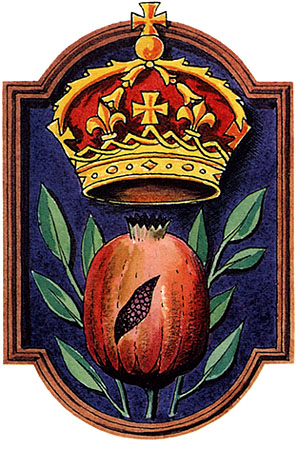
Catherine of Aragon's badge when she was Queen of England

Catherine of Aragon's badge when she was Queen of England

Isabella of Castile embraced the humanist and classical revolution espoused by Erasmus. Her own education had not been thorough, and that planned for her children was academic and detailed. Catherine of Aragon (like her siblings) was well-educated in Latin as well as Spanish, although her texts were principally those written by Christian Romans, such as Augustine, Jerome and Gregory, as well as the moralists from Ancient Rome, such as Seneca.

She was also tutored in Spanish literature, and Spanish translations of stories about King Arthur and Camelot.

Isabella’s own obsession with religion and military matters may have been the reason that Catherine and her sisters were not given the courtly education, including music, singing, poetry and so forth, that most European princesses and aristocrats had.

Nor were they taught the languages of their intended future husbands, which seems a bit odd - so Catherine spoke, fluently, Castilian Spanish and Latin, but not English. Fortunately, her first husband, Prince Arthur, was also well-educated in the classics, so they could communicate in Latin.

Catherine’s religious education was setting her up for trouble in the long term. The rigid views of her parents, particularly her mother, were fortified and strengthened by their victories over the Islamic Moors, and the expulsion of the Jews from Castile and Aragon. One of Catherine’s sisters, Maria, made it a condition of her marriage to the King of Portugal that he follow her parents’ example, and expel all Portugese Jews.

Catherine’s religion was therefore a rigid, militaristic, and non-compromising faith. In the coming Age of Reformation, that would be distinctly awkward.

The Queen and the Prime Minister - Calling a General Election

By Blog author, April 12, 2010 2:24 am

General Elections for the House of Commons

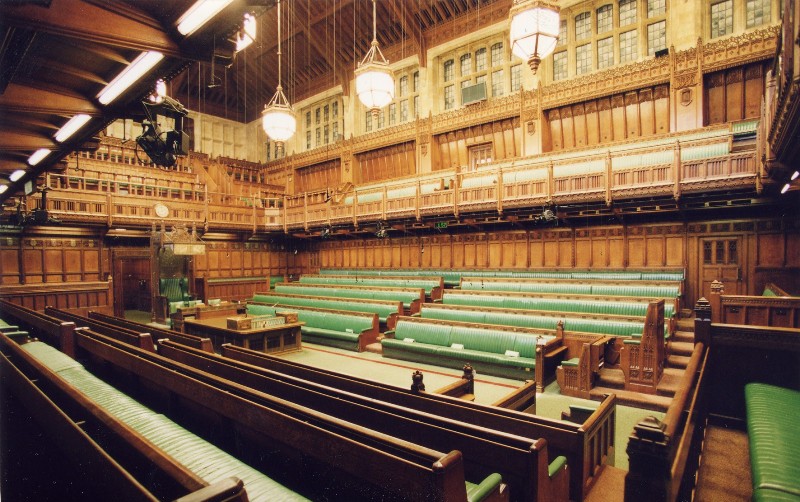
The House of Commons Chamber

The House of Commons Chamber

The main United Kingdom legislature, the House of Commons, is made up of Members of Parliament (MPs) who each represent one parliamentary constituency, or geographical area.

In the General Election held in 2005, there were 646 constituencies, and in the forthcoming 2010 election, there will be 650.

Since coming to the throne, Queen Elizabeth II has had (so far) 11 Prime Minsters, starting with Winston Churchill.

This post is about the calling of a General Election, who does it and how it is done, and how often they are held.

How often are General Elections called?

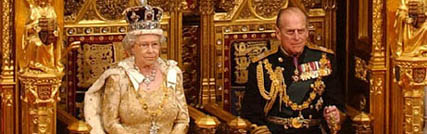
Queen Elizabeth and Prince Phillip at the State Opening of Parliament

Queen Elizabeth and Prince Phillip at the State Opening of Parliament

There is no minimum term for a Parliament.

A General Election can be called at any time, the Queen then dissolves Parliament and a date is set.

The absolute maximum is 5 years, except if everyone agrees it should be longer (during the First World War and the Second World War, coalition Governments held power for longer than 5 years, but short of a serious national emergency, it’s 5 years max). The law is set out in the Parliament Act 1911.

In 1974, for example, there were two General Elections - in February and October.

Since I was born, the period between General Elections has been 4-5 years, tending to be 4 when the Government felt confident, and 5 when it did not. So there were General Elections in 1979, 1983, 1987, 1992, 1997, 2001, 2005, and one must be held in 2010.

Who decides when to hold a General Election

It is the Queen who is responsible for both summoning a Parliament and dissolving it. She acts on the advice of her Prime Minister, so in effect, it’s the Prime Minister and his party who decide when to hold an election. So the Government can choose a time it feels is advantageous to hold the election, or if no such time presents itself, hold on until the bitter end of the 5 year period. The Official Site of the British Monarchy is here.

What happens once the Prime Minister decides to hold a General Election

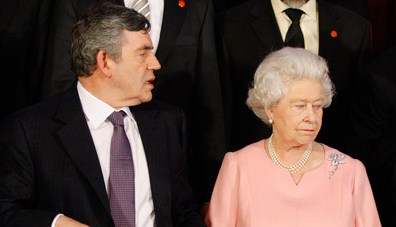
Queen Elizabeth and the Prime Minister, Gordon Brown

Queen Elizabeth and the Prime Minister, Gordon Brown

Once the PM has decided to name the day, he pushes off to Buckingham Palace and asks the Queen to dissolve Parliament, and to summon a new Parliament to advise her.

The date for the General Election is 3-5 weeks after this - in 2010, for example, the Prime Minster (Gordon Brown) went to Buckingham Palace on 6th April to request the dissolution, and the General Election date was set for 6th May.

The BBC’s article on Gordon Brown’s visit to Buckingham Palace can be found here.

The Royal Proclamation

The Queen issues a Royal Proclamation, which sets out the most significant laws passed by her Government since the last General Election, dissolves Parliament, and summons a new Parliament, which will meet after at least 20 days have passed since the Proclamation (Representation of the People Act 1918). She then sends a Royal Messenger, suitably clad in scarlet, to the Houses of Parliament, and he reads the Proclamation to both the House of Commons and the House of Lords.

Armed with a copy of the Royal Proclamation, the Clerk of the Crown in Chancery sends out Election Writs to the Returning Officer in each constituency, telling him to organise the election for that Member of Parliament. (A busy chap, with 650 of them to get out quickly).

And thus the General Election campaigns begin!


The Queen’s Maundy Money: Silver for the Poor on Maundy Thursday

By Blog author, April 2, 2010 2:22 am

The Day Before the Easter Holiday Starts

Every year, the Royal Mint makes special coins, of pure silver, with different values from normal coins.

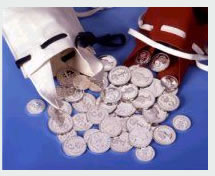
The Queen then takes these coins, placed in specially-made leather purses, and gives her age in pence to a number of men and women equal to her age in a Cathedral ceremony, every Maundy Thursday.

Maundy Thursday, the day before Good Friday, is in many ways the start of the Easter holiday in England.

The Queen's Maundy Money, especially minted, comes in red and white leather purses

The Queen's Maundy Money, especially minted, comes in red and white leather purses


Although it’s a working day, it’s rather like Christmas Eve - lots of people will either take the day off, or make an early get-away for the 4-day Easter weekend. (There is a holiday on Good Friday and a bank holiday on Easter Monday, so it’s a nice break from the regular working routine).

There is a centuries-old tradition of a Maundy ceremony (from c.600 AD) and more recently (since the time of King John or so) a ceremony on Maundy Thursday involving the King or Queen, in which coins are given to the deserving poor.

This post is about the history and practice of the Queen’s Maundy Money.

Origin of the phrase “Maundy Thursday”

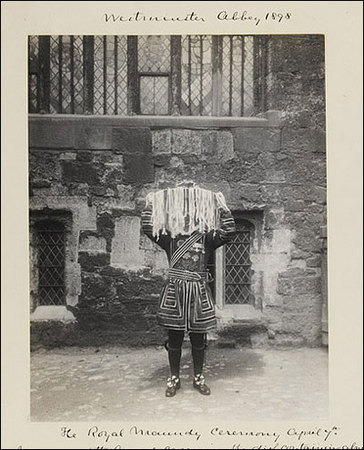
The Queen's Maundy Money ceremony in 1898, at Westminster Abbey

The Queen's Maundy Money ceremony in 1898, at Westminster Abbey

There is not a united view about the origin of the phrase. The most popular idea is that it comes from the phrase Mandatum novum do vobis ut diligatis invicem sicut dilexi vos in the Latin Vulgate Bible, where Christ said to his apostles, A new commandment I give unto you, that ye love one another, as I have loved you. (Gospel according to St. John, 13.34).

Mandatum, which is also the origin of the words “mandatory”, “mandamus” and “mandate”, is thought to be the origin of the “Maundy” part of the phrase, and the “Thursday” part is rather self-explanatory.

Early Maundy Ceremonies

An important part of early Maundy Thursday celebrations was the washing of poor people’s feet, in imitation of Christ, and to show essential humility and the equal-before-God idea (a concept that most medieval bishops honoured more in the breach than the observance, as a general rule).

Foot washing was done by bishops and other important clergymen, and also by the King or Queen, until the mid 17th century - King James II was the last monarch to wash feet personally. The Archbishop of Canterbury, Rowan Williams, does it each Maundy Thursday now.

The washing of feet comes from the Last Supper, where Christ washed the feet of his disciples during the Passover celebrations.

Giving To the Poor

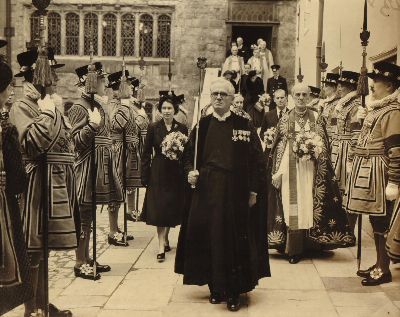
The Queen at the Maundy Money ceremony in 1952, her first public engagement as Queen

The Queen at the Maundy Money ceremony in 1952, her first public engagement as Queen

Anglo-Norman Kings certainly appear to have given alms to the poor on Maundy Thursday.

King John is recorded as having given alms to the poor in Knaresborough, in Yorkshire, when he happened to be there for Holy Week in 1210 AD. He gave knives, clothes and food. (There are lots of references to his giving forks, too. That strikes me as inherently unlikely, because people didn’t use forks for eating until several centuries later).

It is unlikely that King John was the first English King to give alms on this day.

Medieval Maundy Money

The first recorded giving of money to commemorate Maundy Thursday is during the reign of Edward I, who ruled from 1272 (and was King John’s grandson).

The process became more formalised, and more important after the Reformation, as the King or Queen was then not only the ruler of the secular country, but head of the Church of England, too.

Queen Elizabeth II’s Maundy Money

A 3d coin, or thruppeny bit, showing the "young" Queen's head which still appears on Maundy money today

A 3d coin, or thruppeny bit, showing the "young" Queen's head which still appears on Maundy money today

The process has been pretty similar for some decades, now.

Each Maundy Thursday, the Queen gives out Maundy purses at one of England’s Cathedrals. The only exception was in 2008, where the ceremony was held in St. Patrick’s Church of Ireland cathedral, in Armagh, Northern Ireland.

The red and white Maundy purses are given to a number of elderly men and women, chosen now from the local area for charitable and other good works. There is one man and one woman for each of the Queen’s years - so as she is now 84 years old, on 1st April 2010 she gave Maundy money to 84 men and 84 women, in Derby Cathedral.

The white purse contains a £5 coin and a 50p coin, and the red purse contains 1p, 2p, 3p and 4p coins, adding up to the Queen’s age again. So the 84 men and 84 women get 84 pence in coins in their red leather purses.

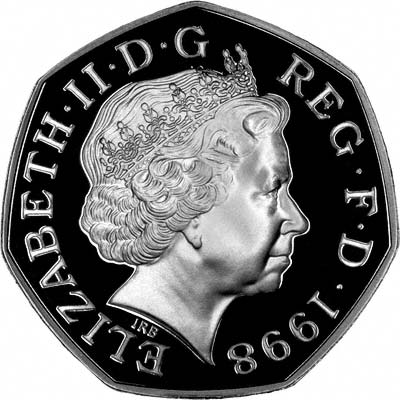
A 50 pence piece in general circulation, showing the Queen's most recent portrait

A 50 pence piece in general circulation, showing the Queen's most recent portrait

The coins are not normal coins. 1p, 2p and 50p coins are in general circulations, but 3p, 4p and £5 coins are not. These coins are all legal tender, for their face value, but are obviously worth a great deal more than 3p or whatever.

Unlike modern coins, which are struck from alloys, the Maundy Money coins are minted each year, from sterling silver, so the coins are 92.5% silver.

In addition, the specially-minted coins feature the first portrait of Elizabeth II, issued on her coins from 1953. This “young portrait” was replaced on normal coins in 1962, but remains on each year’s Maundy Money.

Until 1909, extra sets of Maundy coins were struck and could be purchased. Edward VIII decided to abolish this, and since 1909, the only sets of Maundy coins issued have been to the recipients at the annual ceremony.

Obviously, the number of coins increases each year as the Queen gets older, and the number of pennies issued rises by one, as does the number of men and women who receive them.

The BBC’s article about 2010’s ceremony in Derby can be read here, and the Monarchy’s official article about the ceremony is here.


Historical fiction: Matthew Shardlake and the dark side of Tudor England

By Blog author, December 13, 2009 4:42 am

The good, the bad, and the ugly in historical novels

There is a lot of bad historical fiction around. A good percentage of it is just sex in funny clothes and people saying “forsooth!”, “divers” and “God’s blood”, still in funny clothes.

But good historical fiction is not only an interesting read, it evokes a feel of the time and place, and the undercurrents and emotions of a different time.

“The past is a foreign country, they do things differently there”, but a good historical novel can be an interesting guide book. I enjoy reading good examples of the genre, mostly those set in England.

King Henry VIII, in about 1540

King Henry VIII, in about 1540

This post is a review of one series of books I can highly recommend - C J Sansom’s 4-book (so far) look at Henry VIII’s London, through the eyes of a lawyer in Lincoln’s Inn, one of the four Inns of Court still around today.

The series as a whole

I have really enjoyed these books, and bought them as presents for various family members and friends, as well as reading them myself.

They are not only tightly plotted and well characterised, they really evoke a sense of time and place; Tudor London comes to life in all its religious upheaval, poverty, smell and action.

Our hero

The central character of the books is Matthew Shardlake. He is a barrister, who lives in Chancery Lane, and has chambers in Lincoln’s Inn.

He is originally a rural man, from Hertfordshire, an only child, whose mother died when he was young.

Thomas Cromwell, Earl of Essex, King Henry VIII's chief minister in the 1530s

Thomas Cromwell, Earl of Essex, King Henry VIII's chief minister in the 1530s

He has a hunchback, which alienates him in many ways from a society that sees such physical deformity as bringing bad luck to others.

Matthew was, in his younger days, a keen religious reformer, what we would now call a Protestant.

He’s certainly not perfect - inclined to be melancholy and perhaps over-analytical, but he is a very interesting and credible character.

Dissolution

The first book is set in 1537, 4 years after Henry VIII married Anne Boleyn, and the future Elizabeth I was born, and the year after the execution of Anne Boleyn and Henry’s re-marriage to Jane Seymour.

The Reformation was in full swing in the 1530s. By the time this book starts, all the smaller monasteries had been dissolved, and the King’s chief minister, Thomas Cromwell, had his sights set on the larger, richer, and more powerful monasteries.

Matthew Shardlake is therefore instructed by Cromwell to visit the monastery of Scarnsea, on the south coast (a fictional town and monastic establishment, clearly near Rye and Winchelsea, and sharing much of the characteristics of the Cinque Ports in general). The previous Royal Commissioner has been murdered, and Matthew’s job is to solve the murder and procure the voluntary surrender of Scarnsea’s monastery to the Crown.

The book is set mostly in the monastery, in the depths of a cold winter.

Dark Fire

Anne of Cleves, who became King Henry VIII's fourth wife in 1540

Anne of Cleves, who became King Henry VIII's fourth wife in 1540

The second book is set 3 years later, in 1540. Thomas Cromwell is at risk of falling from power, after arranging the King’s ill-fated marriage to Anne of Cleves. He has been told that dark fire, also known as Greek fire, has been discovered and is desperate to procure this long-lost weapon for Henry VIII.

Cromwell sets Matthew Shardlake on the trail of the dark fire, in return for protecting Matthew’s hapless client, Elizabeth, accused of murdering her young cousin.

For more about the real ancient weapon of Greek Fire, see this article. There is a detailed review of the book in the Guardian, here.

Sovereign

This, the third in the series, is set partly in London, and mostly in York, on the occasion of Henry VIII’s Progress with his new, fifth wife, Catherine Howard. In 1541, following rebellions based in the north of England, Henry went on the grandest Progress of his reign, visiting all sorts of towns, cities, and ports across the country.

Matthew Shardlake is given a post on the Progress, and gets to see his (increasingly grumpy and malevolent) King, and also a secret mission from Thomas Cranmer, Archbishop of Canterbury, who wants him to keep an eye on an important state prisoner, Edward Broderick.

The dark, ever more dangerous environment of Henry VIII’s later years is very well portrayed in this, as is the King himself.

Revelation

In the fourth, and so far last, of the series, Matthew Shardlake and Jack Barak, his assistant, are investigating the case of a boy imprisoned in Bedlam (the Royal Bethlehem hospital) for the insane. The boy is suffering from religious visions and anxieties. There is also a serial killer on the loose, getting more violent and aggressive as he kills more often. Shardlake is once again working for the Archbishop Thomas Cranmer, whose own position looks shaky as Henry VIII pursues yet another wife.

For a review of Revelation from the Times, see here.

Fireworks, Bonfires and Guys - celebrating Guy Fawkes’ Night

By Blog author, November 6, 2009 2:53 am

Gunpowder, Treason and Plot

Contemporary picture of Guy Fawkes being arrested

Contemporary picture of Guy Fawkes being arrested

Guy Fawkes and his group of Catholic fellow-conspirators did their best to blow up Parliament on the 5th November 1605, on the day of the State Opening of Parliament.

Their conspiracy, and the 36 barrels of gunpowder stashed in a cellar under the House of Lords, was discovered hours before the explosion was due.

The “gunpowder plot” and the rebellion that was supposed to follow failed, and James I kept his throne, and the Members of Parliament and Lords stayed alive.

For more about the history and aims of the gunpowder plot, see the previous post on this site.

The defeat of the plot - and the subsequent torture and execution of the plotters - is celebrated annually with great enthusiasm to this day. This post is about the bangs, fires and whimpers of Bonfire Night / Firework Night Guy Fawkes’ Night in England - fireworks, bonfires, burning effigies, and special grub.

The Times has an article about good public displays and events in 2009 here.

Family parties and public events

Guy Fawkes' Night at Windsor Castle, 1776

Guy Fawkes' Night at Windsor Castle, 1776

Lots of people go to big public firework displays, held on commons, heaths and in parks all over the place.

These tend to be on the nearest Saturday to the 5th November, rather than on the actual day (if the 5th November isn’t a Saturday anyway).

Similarly, people often choose to have private parties in their own back gardens, more often on the actual day, whatever day of the week that happens to be.

That way they can also attend a grand display locally, should they choose to do so!

Fireworks

Fireworks are a big part of Guy Fawkes’ Night. It’s perfectly legal to buy fireworks (other than the really big kind) and set them off in your own back garden, and many families do. Mine always did as a child, and we loved it. Bangs and stars in the sky are therefore a common feature of the week or two around the 5th November. Newsagents, supermarkets and other shops usually sell boxes of a selection of fireworks and rockets, and also packets off sparklers, around the start of November.

Bonfires

Bonfires are a big part of the evening. It’s a handy time of year (lots of dead leaves and fallen branches) and helps to keep people warm as well, if it’s chilly. Public celebrations also often have them - in my parents’ village in Kent, they have an enormous bonfire lit on the village green before the fireworks start - it’s usually about 20 - 30 feet tall, and people are cheerfully invited to contribute suitable burning material.

Burning Guys, and “penny for the Guy!”

The Gunpowder plot conspirators, including Guy Fawkes

The Gunpowder plot conspirators, including Guy Fawkes

Traditionally, a figure is burned on the bonfire - a rough model of a man, often about or nearly life-size. This “guy” is supposed to represent Guy Fawkes himself, although in real life, Fawkes was sentenced to be hanged, drawn and quartered, rather than burned.

Until the end of the 19th century, effigies of the Pope and Devil were often burned as well, but such overt anti-Catholicism is rather unfashionable, now.

Unpopular politicians and so forth can find themselves being modelled for bonfires to this day. This year, for example, the Bonfire Society in Edenbridge in Kent intends to burn a 30 foot guy modelled on Jordan, AKA Katie Price (a model). The BBC has written about the plans here.

In my family, when I was a child, we made a guy every year from sacks or similar, and clothed him in ragged old jumpers unfit for anything else. A face was drawn on with pen, and chunks of wool for hair. Not great works of art, but fun to make.

Just before the bonfire is lit, the effigy is slung on the top, to burn with the fire.

It used to be much more common for children to make a guy, and trundle it round the streets in a pushchair or trolley, shouting, “penny for the guy” in order to collect funds for fireworks. The more impressively-created the guy, the more money could be expected. It happens less now, especially because children aren’t allowed to buy fireworks any more - a buyer has to be over 18. It’s still pretty common for a guy for a village event to be left out with a collecting tin, to gather funds for a firework display.

Food

There are certain foods which are traditionally-eaten on Bonfire Night - some are traditional nationally, others only in one region or county.

Common across the country is a meal of sausages, jacket potatoes, and baked beans, or similar. The potatoes can be wrapped in foil and put at the edge of the bonfire to cook.

Treacle toffee (darker and much less sweet than normal toffee) and toffee apples are common.

“Parkin” is a common Bonfire Night all over the country, but the actual recipe for this varies hugely. Same name, rather different food! Mostly, it’s a type of soft, treacle-based cake, made with both oats and flour.

Famous Bonfire Night Celebrations

Burning crosses symbolising 17 protestant martyrs in Lewes

Burning crosses symbolising 17 protestant martyrs in Lewes

There are many local traditions and societies, so I’ll only mention a couple of the biggest and best-known.

Lewes, a town in East Sussex, has a particularly enthusiastic group of Bonfire Societies.

Each of the 7 main societies creates at least one elaborate effigy - Guy Fawkes predominates, local and national politicians often also feature.

There are also models of people’s heads on pikes (a type of spear), often modelled after unpopular members of the town council, or those who opposed the Lewes festivities.

Societies, each with mottos and caps, parade their effigies and heads through the streets, carrying fire torches and similar.

Smugglers in the Cliffe Bonfire Society's parade in Lewes

Many people in the parades are dressed up - Zulus, smugglers and Elizabethans are particularly common.

The parades end in bonfires and firework displays. Lewes is a small town, but crowds of up to 80,000 are common, and roads, car parks etc are closed down for the evening.

You can find the Lewes Bonfire Council’s website here.

I’ve been to the Lewes event a couple of times - my uncle lives near by. It’s awe-inspiring, mad, and fantastic fun.

Ottery St Mary in Devon is a small town with a very odd Guy Fawkes tradition. The first part of the Carnival consists of costume parades and fireworks (so far, so normal).

The second part is made up of men, women and children carrying tar barrels through the streets, while those barrels are on fire.

A man carrying a flaming tar barrel in Ottery St Mary

A man carrying a flaming tar barrel in Ottery St Mary

There are 17 barrels, all lovingly-coated with coal tar over some months, and then filled with hay or paper.

Each is lit outside a traditional pub, shop, or hotel, throughout the afternoon and evening, and then people take it in turns to run through the streets, carrying the flaming barrels.

It’s a family-based tradition - people in the same families tend to carry barrels from the same pubs down the years.

The Ottery St Mary tar barrel site is to be found here.


Guy Fawkes - Gunpowder, Treason and Plot

By Blog author, November 5, 2009 11:59 pm

What’s Guy Fawkes’ Night AKA Bonfire Night AKA Fireworks Night all about?

The conspirators in the Gunpowder Plot, from a contemporary drawing

The conspirators in the Gunpowder Plot, from a contemporary drawing

If you are anywhere in the UK tonight, you are probably either at a Bonfire Night party, a Guy Fawkes’ Night bash, or hearing the cracks and bangs and seeing the stars out of the window from other people’s celebrations.

The gunpowder plot, the failure of which is commemorated every 5th November, was an audacious plan to blow up the Houses of Parliament on 5th November 1605.

It was the day of the State Opening of Parliament, and the plotters hoped to kill pretty much everyone involved in the government in one fell swoop - King James I, Members of Parliament, and the Lords Spiritual and Temporal (the House of Lords mob).

And now, 400 and more years later, it’s a big, annual event here, still. So this post will tell you all about the history of the gunpowder plot, and how its failure turned into the celebration of Guy Fawkes’ Night. The next post on this blog will be about the celebration of Bonfire Night to this very day.

Guy Fawkes' signature after torture

Guy Fawkes' signature after torture

As a poet wrote (in slightly doggerel form) at the time of the gunpowder plot:

Remember, remember the fifth of November,
The gunpowder treason and plot,
I know of no reason
Why gunpowder treason should ever be forgot.

The Gunpowder Plot

Led by Robert Catesby, a group of disgruntled Catholics, who had hoped the accession of James I would lead to greater religious toleration, and had been disappointed in their expectations, had a big idea.

They decided to blow up the government, kill the King at the same time, dispose of most of his family, kidnap his 9 year old daughter, Elizabeth, lead a country-wide rebellion based in the Midlands, and then put Elizabeth on the throne as Queen of England and Scotland.

Elizabeth of Bohemia, intended (by the gunpowder plotters) to be the next Queen of England

Elizabeth of Bohemia, intended (by the gunpowder plotters) to be the next Queen of England

Guy Fawkes was a Roman Catholic who had fought for the (Catholic) Spanish Empire for at least 10 years, known in Spain as Guido Fawkes. He had a lot of experience of blowing things up, and became the man in charge of the Gunpowder Plot attempt to blow up Parliament.

In May 1604, one of the plotters, Thomas Percy, rented rooms next to the House of Lords, intending to tunnel underneath the House and put gunpowder there. The plotters started their excavations, but a nasty outbreak of plague caused the State Opening of Parliament to be put back to 1605.

A cellar under the House of Lords became vacant, and Thomas Percy quickly grabbed the lease and rented it. Guy Fawkes then arranged for 36 barrels of gunpowder to be put in the cellar, covered with firewood (36 barrels of gunpowder blowing up in one go would cause a pretty impressive explosion, by all accounts).

By March 1605, the gunpowder was all in place, and the conspirators moved on to planning the rebellion.


How it all went wrong

As the State Opening drew closer, Guy Fawkes prepared to supervise the explosion, and the rest of the plotters made their way to the Midlands, to start the rebellion once Parliament had been blown to smithereens.

At least some of the plotters were worried about blowing up fellow-Catholics attending the event. At the end of October, an anonymous letter was sent to Lord Monteagle, a prominent Catholic, saying, retyre youre self into yowre contee whence yow maye expect the event in safti for … they shall receyve a terrible blowe this parleament (retire yourself into your county, where you may expect the event in safety, for… they shall receive a terrible blow this parliament).

Lord Monteagle, being a public-spirited sort of chap, brought the letter to the attention of Robert Cecil, Secretary of State and Earl of Salisbury, who showed it to the King. A search of the Parliament was ordered, and in the early hours of the morning of the 5th November, D-Day, as it were, Thomas Knyvet arrested Guy Fawkes leaving the gunpowder cellar.

The aftermath, torture, and executions

The execution of Guy Fawkes, from a 17th century print. Showing all sorts of cheerful hanging, drawing and quartering

The execution of Guy Fawkes, from a 17th century print. Showing all sorts of cheerful hanging, drawing and quartering

Guy Fawkes gave a false name (Johnson) and was held in the Tower of London. He claimed he had been acting alone, and later under torture gave the names only of plotters already caught.

Torture was only allowed by Royal Warrant or by the order of the Star Chamber, but James I cheerfully gave his written orders for torture to be carried out, writing

“The gentler tortures are to be first used unto him, et sic per gradus ad maiora tenditur” (“and thus by steps extended to greater ones, in English”), “and so God speed your good work.”

The Midlands rebellion was attempted, but fizzled out.

The plotters were tried in Westminster Hall, part of the House of Parliament to this day, in a grand public event, on 27th January 1606.

With a certain judicial swiftness, the men were found guilty in the one-day trial, and executed on 30th January in St. Paul’s Cathedral in the City of London (4 men) and the rest, including Fawkes, were hanged drawn and quarted in Westminster on 31st January.

Fawkes managed to evade the really nasty bits of his punishment by jumping as he was hanged, so he wasn’t still alive to have his entrails removed and be chopped into bits.

James I gave a speech to Parliament a few days after the discovery of the plot, in which he described its failure as a miracle, and explained how it had confirmed his belief in the Divine Right of Kings.

It was that belief of the Stuart Kings which lead to all sorts of trouble later in the century, most notably, the regicide of King Charles II and the establishment of the Puritan Commonwealth under Oliver Cromwell.

And this torture, trial and execution is generally and cheerfully celebrated yearly in England!


The Eleanor Crosses: King Edward I’s 12 stone statues showing love and grief for his wife

By Blog author, June 25, 2009 1:06 am

When his wife, Eleanor of Castile, died Edward I spoke of her as the woman, “whom living we dearly cherished, and whom dead we cannot cease to love”.

Edward commissioned 12 large and elaborate stone crosses to stand in each of the places at which her funeral procession rested overnight, on the journey from Lincoln to Westminster Abbey in London.

This article is about Edward, Eleanor, and the 12 Eleanor Crosses.

Eleanor’s early life

Statue of Eleanor of Castile, from the Northampton Eleanor Cross

Statue of Eleanor of Castile, from the Northampton Eleanor Cross

Eleanor of Castile was born the daughter of Ferdinand King of Castile and his second wife, Jeanne.

She was their second child, and was born in 1241 (the exact date isn’t known, but probably at the end of the year).

Eleanor married Edward I, future King of England, in Burgos on 1st November 1254; Burgos is in the north of Spain. At the time of the marriage, Eleanor was either 13 years old, or coming up to 13 shortly.

Edward I’s early life

Edward I, often nicknamed “Hammer of the Scots” or Scottorum Malleus was also known as “Edward Longshanks”. He was unusually tall for medieval times, and is thought to have been about 6 foot 2 inches tall.

A few centuries after he died, someone dug him up and measured the bones. Nice.

King Edward I

King Edward I

Edward was born on 17th June 1239, son and heir of King Henry III and Eleanor of Provence.

Edward and Eleanor’s marriage was entirely political and arranged by their parents. The young couple had no say in it whatsoever.

Following his father’s death, Edward became King of England and Eleanor, Queen, on 16th November 1272.

Edward and Eleanor’s marriage and children

Although an arranged marriage, the couple appeared to have grown very close. They had either 15 or 16 children.

Their first daughter was stillborn, the second, Katherine, died as a baby, as did the third, Joan. John died at the age of 5, their next son Henry died at the age of 6.

Their sixth child, Eleanor lived until the age of 29, but their next unnamed daughter died at the age of a few months.

Their eighth child, Joan of Acre, lived to adulthood, and had eight children in total. Their next child, Alphonso, died at the age of 10. Their tenth child Margaret lived to adulthood, and had a son, but their next four children, daughters Berengaraia, an unnamed daughter, Mary and an unnamed son all died as babies or infants.

Elizabeth of Rhuddlan, daughter of Edward I and Eleanor of Castile

Elizabeth of Rhuddlan, daughter of Edward I and Eleanor of Castile

Their fifteen child, Elizabeth of Rhuddlan, lived to adulthood and had ten children, and their sixteenth and last child, Edward of Caernarvon, lived to succeed his father and become King Edward II.

The couple appeared to have been happy together. Unlike medieval kings, Edward I had no known mistresses or bastard children.

Eleanor also travelled with him on his military activities. For example, she gave birth to their final son and eventual heir, Edward, in a tent where Caernarvon Castle was being built to subdue the west in 1284.

The Catholic Church in medieval times officially forbade all sexual relations even between husband and wife during Lent.

It can been seen from the household accounts kept by the royal household and which survive that each year on Easter Monday Eleanor’s Ladies in Waiting pretended to hold hostage in his own bed in his own room until he paid them a ransom so that he could visit his wife’s bedroom for the first time since before Lent.


What is known about Eleanor of Castile

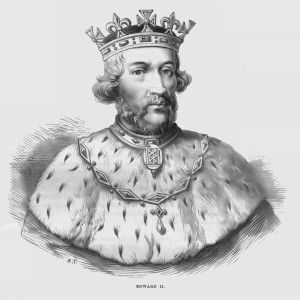
King Edward II, son of Edward I and Eleanor of CastileAs is common, not a huge amount is known about Eleanor. Even queens in medieval times were still just women and therefore not terribly important. What evidence survives does show, however, that she was well educated and intelligent.

Eleanor employed several scribes and an illuminator, or illustrator, paid for from her household accounts, to find and copy books for her to read (in the time before printing, books were extremely expensive, as they could only be produced by somebody copying the entire thing by hand).

She also commissioned works to be written for her, including Saints’ lives and romances. She entered into correspondence with abbots and professors at Oxford regarding matters as diverse as the theories in relation to angels, treaties on chess, and monastic orders.

The death of Queen Eleanor

In autumn 1290, Edward and Eleanor were told that Margaret, heir to the Scottish throne, had died. Edward and Eleanor were in Nottinghamshire, as a parliament had just been held there. Edward and Eleanor left Clipstone, where the parliament had been held, and went towards Lincoln.

When they reached the Valley of Harby in Nottinghamshire, about 8 miles from the city of Lincoln, the Queen’s existing illness became worse. She died in Harby on 28th November 1290, aged about 49 years old. Edward was at her bedside as she died.

After she died, Eleanor of Castile’s body was taken to the Gilbertine Priory of St Catherine, Lincoln.

The Gilbertine Order was an unusual one in that it was the only monastic order to be founded in England. The order therefore ceased to exist at the dissolution of the monasteries by Henry VIII in the 1530s. Gilbertine priories were also unusual in that they featured monks and nuns living in the same establishment. The common layout for Gilbertine priories was to have nuns’ quarters in the north of the precinct, monks in the south, and a church, refectory and other common buildings in between.

The Priory of St Catherine where Eleanor was taken is described as being in Lincoln, but that is only true for the site today. At the time when Eleanor of Castile’s body was taken there, the Priory was south of Lincoln proper, and outside the city walls. It therefore had substantial walls to protect it.

Eleanor’s burials, and burial procession

Eleanor of Castile’s body was embalmed and dissected at the Priory of St Catherine. Rather revoltingly, to modern eyes, different bits of her body were buried in different places, her viscera, namely her stomach and bowels or guts, were buried in Lincoln at the Visceral Tomb in the Angel Choir at Lincoln Cathedral.

The rest of her body was then sent to London. The procession took twelve days to reach Westminster Abbey, where most of her would be buried, and the Eleanor Crosses were built to mark the places where her funeral cortege rested overnight.

On reaching London, she was buried in Westminster Abbey, apart from her heart which was buried in the Dominican monastery at Blackfriars.

The Visceral Tomb in Lincoln Cathedral survives, although the effigy of Eleanor of Castile which was on top of the Tomb was destroyed in the 17th century during the time when puritans got very upset about such idolatry (as they saw it).

Westminster Abbey, where most of Eleanor of Castile's body was buried

Westminster Abbey, where most of Eleanor of Castile's body was buried

The procession of Eleanor’s body to London was a grand one. King Edward I accompanied the procession the whole way.

Eleanor’s body was temporarily placed in a general tomb near the high alter in Westminster Abbey which had contained the body of father-in-law King Henry III until his remains were removed to his finally completed grand tomb earlier in 1290.

After Eleanor’s tomb was built, her body was moved from the grave to her own tomb. That tomb still survives, although has been damaged a little over the years.

Edward I’s 12 Eleanor crosses

The twelve Crosses erected by Edward I were probably designed not only to show his love and respect for his wife but to encourage people to pray for her soul. Twelve Crosses were originally built, but only three of them remain more or less intact, although bits of others can still be found.

Each of the Crosses were slightly different in style. Each had a plinth of steps at the bottom, and was built in three stages further up. At the bottom, the column was adorned with Eleanor’s heraldic symbols, and the Coat of Arms representing Castile, England and Ponthieu. Higher up, statues of the Queen were around the column, and the third part continued the column upwards became thinner, and was surmounted by a cross.

The Lincoln Eleanor Cross

The first Cross was built just outside the walls of the Gilbertine St Catherine’s Priory south of Lincoln. The Priory was destroyed following the dissolution of the monasteries, and a small piece of the Cross is all that survives. It is now in Lincoln Castle.

The Grantham Eleanor Cross

The next Cross was built at Grantham, a market town south of Lincoln but still in the county of Lincolnshire. That Cross has disappeared entirely, no remnants remain. The Cross at Grantham was destroyed by Oliver Cromwell’s forces in the 17th century.

The Stamford Eleanor Cross

The next overnight resting place, and therefore the next Eleanor Cross was in Stamford, also in Lincolnshire. A small piece of that Cross survives, which is a stone carved rose. The rose is in the museum in Stamford.

Recently, a thirty feet high statue made of bronze and stone has been put up in Sheepmarket, Stamford, but it is not intended as an exact replica of the original Eleanor Cross, is not in the same place, and is supposed to recall and inspire rather than replicate the original Eleanor Cross.

The Cross in Stamford was, as in Grantham, destroyed by Oliver Cromwell’s forces.

The Geddington Eleanor Cross

Plans and sketches of the Eleanor Cross at Geddington

Plans and sketches of the Eleanor Cross at Geddington

The next Eleanor Cross is at Geddington, which is in the north-east of Northamptonshire.

The Eleanor Cross at Geddington survives, and is probably the best preserved of all of them, and still stands in the original location where it was built in 1293.

The Cross is, like all the Eleanor Crosses were, mounted on hexagonal staircases, and then features a long slim column, narrowing towards the top, with statues around it.

The Geddington Cross was different from the other 11, in that the cross was more triangular in shape than the others.

It is preserved and looked after by English Heritage, and their page on the Eleanor Cross at Geddington can be found here.

The Geddington Cross has three statues of Eleanor halfway up the column. The Cross originally mounted at the top of the Geddington statue has not survived.
The Hardingstone, Northampton Eleanor Cross

Drawings of the Eleanor Cross at Hardingstone, Northampton

Drawings of the Eleanor Cross at Hardingstone, Northampton

The next Cross was erected at Hardingstone in Northamptonshire. This Cross is octagonal, and sites on a plinth of steps which are replacements.

It is different in both shape and style to the Geddington Cross, but has similar features in the statues of Eleanor in the second part and the narrowing part at the top.

At the bottom of the Eleanor Cross in Hardingstone are carved stone books, which were originally painted with prayers for Eleanor’s soul to be said by those who read them.

The Stony Stratford Eleanor Cross

The next Cross is at Stony Stratford. This parish is now part of Milton Keynes, and is in Buckinghamshire, near the border with Northamptonshire. The Cross appears to have been of a similar to design to that at Geddington, and was destroyed by Cromwell’s armies in the Civil War in the 17th century.

The Woburn and Dunstable Eleanor Crosses

The next Cross was at Woburn in Bedfordshire. There are no surviving remnants of the statue and it’s not known precisely where in the town it stood.

The next Cross was erected at Dunstable in Bedfordshire. The Dunstable Cross no longer exists.

The St. Albans Eleanor Cross

The Waltham Eleanor Cross in the early 1920s

The Waltham Eleanor Cross in the early 1920s

The next one is at St Albans in Hertfordshire. It was in front of the Clock Tower, which is 15th century, in the high street, opposite one of the entrances to St Albans Abbey.

This cross was demolished in the 1720s and replaced by a town pump, as it was in poor repair.

The Waltham Cross Eleanor Cross

You’ll never guess where this town got the second part of its name from… This cross is in pretty good repair, and still standing in its original location.

The statues were removed to a local museum in the 1980s to protect them from pollution.

The Westcheap / Cheapside Eleanor Cross

The Westcheap / Cheapside Eleanor Cross shown in a 1630 drawing

The Westcheap / Cheapside Eleanor Cross shown in a 1630 drawing

The last but one Cross was in Westcheap, now known as Cheapside. This was demolished under orders from the puritan parliament in 1643.

There are several drawings and pictures of it as well as fragments of the remains in the Museum of London, so what it looks like is still known.

The Charing Cross Eleanor Cross

The last Cross was built at Charing, now called Charing Cross and a major railway terminus in London.

The statue was originally not where the railway station is today, but nearby on the south side of Trafalgar Square. At the time, this site was part of the Royal Mews attached to Westminster Palace.

Distances in London and from London to other places in the United Kingdom are measured from this point in Trafalgar square according to statutory interpretation.

The current Eleanor Cross which can be seen in the foreground of the Charing Cross Station forecourt is a replica.

The original was the most expensive, largest, and grandest of the Eleanor statues and was built from marble, rather than cheaper stone.

The replacement Eleanor Cross is 70 feet high, and was built by the South Eastern Railway Company when they built the station and the hotel above it. There are many drawings of the original and fragments and those drawings are in the Museum of London.

The Eleanor Cross at Charing, in the late 19th century

The Eleanor Cross at Charing, in the late 19th century


Panorama theme by Themocracy