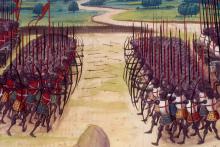
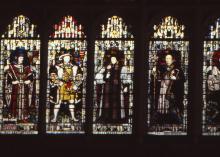
In 1066, a Norman expedition invaded and conquered England. The Norman dynasty established by William the Conqueror ruled England for over half a century before the period of succession crisis known as the Anarchy (1135–1154). Following the Anarchy, England came under the rule of the House of Plantagenet, a dynasty which later inherited claims to the Kingdom of France. During this period, Magna Carta was signed. A succession crisis in France led to the Hundred Years' War (1337–1453), a series of conflicts involving the peoples of both nations. Following the Hundred Years' Wars, England became embroiled in its own succession wars. The Wars of the Roses pitted two branches of the House of Plantagenet against one another, the House of York and the House of Lancaster. The Lancastrian Henry Tudor ended the War of the Roses and established the Tudor dynasty in 1485.
Under the Tudors and the later Stuart dynasty, England became a colonial power. During the rule of the Stuarts, the English Civil War took place between the Parliamentarians and the Royalists, which resulted in the execution of King Charles I (1649) and the establishment of a series of republican governments — first, a Parliamentary republic known as the Commonwealth of England (1649–1653), then a military dictatorship under Oliver Cromwell known as The Protectorate (1653–1659). The Stuarts returned to the restored throne in 1660, though continued questions over religion and power resulted in the deposition of another Stuart king, James II, in the Glorious Revolution (1688). England, which had subsumed Wales in the 16th century under Henry VIII, united with Scotland in 1707 to form a new sovereign state called Great Britain.[4][5][6] Following the Industrial Revolution, Great Britain ruled a colonial Empire, the largest in recorded history. Following a process of decolonisation in the 20th century, mainly caused by the weakening of Great Britain's power in the two World Wars, almost all of the empire's overseas territories became independent countries. However, as of 2018, its cultural impact remains widespread and deep in many of them.